Found 857 repositories(showing 30)
Datus-ai
The Future of Data Engineering — A CLI SQL client for the modern data stack, enabling AI-native context engineering for data.
jettbrains
W3C Strategic Highlights September 2019 This report was prepared for the September 2019 W3C Advisory Committee Meeting (W3C Member link). See the accompanying W3C Fact Sheet — September 2019. For the previous edition, see the April 2019 W3C Strategic Highlights. For future editions of this report, please consult the latest version. A Chinese translation is available. ☰ Contents Introduction Future Web Standards Meeting Industry Needs Web Payments Digital Publishing Media and Entertainment Web & Telecommunications Real-Time Communications (WebRTC) Web & Networks Automotive Web of Things Strengthening the Core of the Web HTML CSS Fonts SVG Audio Performance Web Performance WebAssembly Testing Browser Testing and Tools WebPlatform Tests Web of Data Web for All Security, Privacy, Identity Internationalization (i18n) Web Accessibility Outreach to the world W3C Developer Relations W3C Training Translations W3C Liaisons Introduction This report highlights recent work of enhancement of the existing landscape of the Web platform and innovation for the growth and strength of the Web. 33 working groups and a dozen interest groups enable W3C to pursue its mission through the creation of Web standards, guidelines, and supporting materials. We track the tremendous work done across the Consortium through homogeneous work-spaces in Github which enables better monitoring and management. We are in the middle of a period where we are chartering numerous working groups which demonstrate the rapid degree of change for the Web platform: After 4 years, we are nearly ready to publish a Payment Request API Proposed Recommendation and we need to soon charter follow-on work. In the last year we chartered the Web Payment Security Interest Group. In the last year we chartered the Web Media Working Group with 7 specifications for next generation Media support on the Web. We have Accessibility Guidelines under W3C Member review which includes Silver, a new approach. We have just launched the Decentralized Identifier Working Group which has tremendous potential because Decentralized Identifier (DID) is an identifier that is globally unique, resolveable with high availability, and cryptographically verifiable. We have Privacy IG (PING) under W3C Member review which strengthens our focus on the tradeoff between privacy and function. We have a new CSS charter under W3C Member review which maps the group's work for the next three years. In this period, W3C and the WHATWG have succesfully completed the negotiation of a Memorandum of Understanding rooted in the mutual belief that that having two distinct specifications claiming to be normative is generally harmful for the Web community. The MOU, signed last May, describes how the two organizations are to collaborate on the development of a single authoritative version of the HTML and DOM specifications. W3C subsequently rechartered the HTML Working Group to assist the W3C community in raising issues and proposing solutions for the HTML and DOM specifications, and for the production of W3C Recommendations from WHATWG Review Drafts. As the Web evolves continuously, some groups are looking for ways for specifications to do so as well. So-called "evergreen recommendations" or "living standards" aim to track continuous development (and maintenance) of features, on a feature-by-feature basis, while getting review and patent commitments. We see the maturation and further development of an incredible number of new technologies coming to the Web. Continued progress in many areas demonstrates the vitality of the W3C and the Web community, as the rest of the report illustrates. Future Web Standards W3C has a variety of mechanisms for listening to what the community thinks could become good future Web standards. These include discussions with the Membership, discussions with other standards bodies, the activities of thousands of participants in over 300 community groups, and W3C Workshops. There are lots of good ideas. The W3C strategy team has been identifying promising topics and invites public participation. Future, recent and under consideration Workshops include: Inclusive XR (5-6 November 2019, Seattle, WA, USA) to explore existing and future approaches on making Virtual and Augmented Reality experiences more inclusive, including to people with disabilities; W3C Workshop on Data Models for Transportation (12-13 September 2019, Palo Alto, CA, USA) W3C Workshop on Web Games (27-28 June 2019, Redmond, WA, USA), view report Second W3C Workshop on the Web of Things (3-5 June 2019, Munich, Germany) W3C Workshop on Web Standardization for Graph Data; Creating Bridges: RDF, Property Graph and SQL (4-6 March 2019, Berlin, Germany), view report Web & Machine Learning. The Strategy Funnel documents the staff's exploration of potential new work at various phases: Exploration and Investigation, Incubation and Evaluation, and eventually to the chartering of a new standards group. The Funnel view is a GitHub Project where new area are issues represented by “cards” which move through the columns, usually from left to right. Most cards start in Exploration and move towards Chartering, or move out of the funnel. Public input is welcome at any stage but particularly once Incubation has begun. This helps W3C identify work that is sufficiently incubated to warrant standardization, to review the ecosystem around the work and indicate interest in participating in its standardization, and then to draft a charter that reflects an appropriate scope. Ongoing feedback can speed up the overall standardization process. Since the previous highlights document, W3C has chartered a number of groups, and started discussion on many more: Newly Chartered or Rechartered Web Application Security WG (03-Apr) Web Payment Security IG (17-Apr) Patent and Standards IG (24-Apr) Web Applications WG (14-May) Web & Networks IG (16-May) Media WG (23-May) Media and Entertainment IG (06-Jun) HTML WG (06-Jun) Decentralized Identifier WG (05-Sep) Extended Privacy IG (PING) (30-Sep) Verifiable Claims WG (30-Sep) Service Workers WG (31-Dec) Dataset Exchange WG (31-Dec) Web of Things Working Group (31-Dec) Web Audio Working Group (31-Dec) Proposed charters / Advance Notice Accessibility Guidelines WG Privacy IG (PING) RDF Literal Direction WG Timed Text WG CSS WG Web Authentication WG Closed Internationalization Tag Set IG Meeting Industry Needs Web Payments All Web Payments specifications W3C's payments standards enable a streamlined checkout experience, enabling a consistent user experience across the Web with lower front end development costs for merchants. Users can store and reuse information and more quickly and accurately complete online transactions. The Web Payments Working Group has republished Payment Request API as a Candidate Recommendation, aiming to publish a Proposed Recommendation in the Fall 2019, and is discussing use cases and features for Payment Request after publication of the 1.0 Recommendation. Browser vendors have been finalizing implementation of features added in the past year (view the implementation report). As work continues on the Payment Handler API and its implementation (currently in Chrome and Edge Canary), one focus in 2019 is to increase adoption in other browsers. Recently, Mastercard demonstrated the use of Payment Request API to carry out EMVCo's Secure Remote Commerce (SRC) protocol whose payment method definition is being developed with active participation by Visa, Mastercard, American Express, and Discover. Payment method availability is a key factor in merchant considerations about adopting Payment Request API. The ability to get uniform adoption of a new payment method such as Secure Remote Commerce (SRC) also depends on the availability of the Payment Handler API in browsers, or of proprietary alternatives. Web Monetization, which the Web Payments Working Group will discuss again at its face-to-face meeting in September, can be used to enable micropayments as an alternative revenue stream to advertising. Since the beginning of 2019, Amazon, Brave Software, JCB, Certus Cybersecurity Solutions and Netflix have joined the Web Payments Working Group. In April, W3C launched the Web Payment Security Group to enable W3C, EMVCo, and the FIDO Alliance to collaborate on a vision for Web payment security and interoperability. Participants will define areas of collaboration and identify gaps between existing technical specifications in order to increase compatibility among different technologies, such as: How do SRC, FIDO, and Payment Request relate? The Payment Services Directive 2 (PSD2) regulations in Europe are scheduled to take effect in September 2019. What is the role of EMVCo, W3C, and FIDO technologies, and what is the current state of readiness for the deadline? How can we improve privacy on the Web at the same time as we meet industry requirements regarding user identity? Digital Publishing All Digital Publishing specifications, Publication milestones The Web is the universal publishing platform. Publishing is increasingly impacted by the Web, and the Web increasingly impacts Publishing. Topic of particular interest to Publishing@W3C include typography and layout, accessibility, usability, portability, distribution, archiving, offline access, print on demand, and reliable cross referencing. And the diverse publishing community represented in the groups consist of the traditional "trade" publishers, ebook reading system manufacturers, but also publishers of audio book, scholarly journals or educational materials, library scientists or browser developers. The Publishing Working Group currently concentrates on Audiobooks which lack a comprehensive standard, thus incurring extra costs and time to publish in this booming market. Active development is ongoing on the future standard: Publication Manifest Audiobook profile for Web Publications Lightweight Packaging Format The BD Comics Manga Community Group, the Synchronized Multimedia for Publications Community Group, the Publishing Community Group and a future group on archival, are companions to the working group where specific work is developed and incubated. The Publishing Community Group is a recently launched incubation channel for Publishing@W3C. The goal of the group is to propose, document, and prototype features broadly related to: publications on the Web reading modes and systems and the user experience of publications The EPUB 3 Community Group has successfully completed the revision of EPUB 3.2. The Publishing Business Group fosters ongoing participation by members of the publishing industry and the overall ecosystem in the development of Web infrastructure to better support the needs of the industry. The Business Group serves as an additional conduit to the Publishing Working Group and several Community Groups for feedback between the publishing ecosystem and W3C. The Publishing BG has played a vital role in fostering and advancing the adoption and continued development of EPUB 3. In particular the BG provided critical support to the update of EPUBCheck to validate EPUB content to the new EPUB 3.2 specification. This resulted in the development, in conjunction with the EPUB3 Community Group, of a new generation of EPUBCheck, i.e., EPUBCheck 4.2 production-ready release. Media and Entertainment All Media specifications The Media and Entertainment vertical tracks media-related topics and features that create immersive experiences for end users. HTML5 brought standard audio and video elements to the Web. Standardization activities since then have aimed at turning the Web into a professional platform fully suitable for the delivery of media content and associated materials, enabling missing features to stream video content on the Web such as adaptive streaming and content protection. Together with Microsoft, Comcast, Netflix and Google, W3C received an Technology & Engineering Emmy Award in April 2019 for standardization of a full TV experience on the Web. Current goals are to: Reinforce core media technologies: Creation of the Media Working Group, to develop media-related specifications incubated in the WICG (e.g. Media Capabilities, Picture-in-picture, Media Session) and maintain maintain/evolve Media Source Extensions (MSE) and Encrypted Media Extensions (EME). Improve support for Media Timed Events: data cues incubation. Enhance color support (HDR, wide gamut), in scope of the CSS WG and in the Color on the Web CG. Reduce fragmentation: Continue annual releases of a common and testable baseline media devices, in scope of the Web Media APIs CG and in collaboration with the CTA WAVE Project. Maintain the Road-map of Media Technologies for the Web which highlights Web technologies that can be used to build media applications and services, as well as known gaps to enable additional use cases. Create the future: Discuss perspectives for Media and Entertainment for the Web. Bring the power of GPUs to the Web (graphics, machine learning, heavy processing), under incubation in the GPU for the Web CG. Transition to a Working Group is under discussion. Determine next steps after the successful W3C Workshop on Web Games of June 2019. View the report. Timed Text The Timed Text Working Group develops and maintains formats used for the representation of text synchronized with other timed media, like audio and video, and notably works on TTML, profiles of TTML, and WebVTT. Recent progress includes: A robust WebVTT implementation report poises the specification for publication as a proposed recommendation. Discussions around re-chartering, notably to add a TTML Profile for Audio Description deliverable to the scope of the group, and clarify that rendering of captions within XR content is also in scope. Immersive Web Hardware that enables Virtual Reality (VR) and Augmented Reality (AR) applications are now broadly available to consumers, offering an immersive computing platform with both new opportunities and challenges. The ability to interact directly with immersive hardware is critical to ensuring that the web is well equipped to operate as a first-class citizen in this environment. The Immersive Web Working Group has been stabilizing the WebXR Device API while the companion Immersive Web Community Group incubates the next series of features identified as key for the future of the Immersive Web. W3C plans a workshop focused on the needs and benefits at the intersection of VR & Accessibility (Inclusive XR), on 5-6 November 2019 in Seattle, WA, USA, to explore existing and future approaches on making Virtual and Augmented Reality experiences more inclusive. Web & Telecommunications The Web is the Open Platform for Mobile. Telecommunication service providers and network equipment providers have long been critical actors in the deployment of Web technologies. As the Web platform matures, it brings richer and richer capabilities to extend existing services to new users and devices, and propose new and innovative services. Real-Time Communications (WebRTC) All Real-Time Communications specifications WebRTC has reshaped the whole communication landscape by making any connected device a potential communication end-point, bringing audio and video communications anywhere, on any network, vastly expanding the ability of operators to reach their customers. WebRTC serves as the corner-stone of many online communication and collaboration services. The WebRTC Working Group aims to bringing WebRTC 1.0 (and companion specification Media Capture and Streams) to Recommendation by the end of 2019. Intense efforts are focused on testing (supported by a dedicated hackathon at IETF 104) and interoperability. The group is considering pushing features that have not gotten enough traction to separate modules or to a later minor revision of the spec. Beyond WebRTC 1.0, the WebRTC Working Group will focus its efforts on WebRTC NV which the group has started documenting by identifying use cases. Web & Networks Recently launched, in the wake of the May 2018 Web5G workshop, the Web & Networks Interest Group is chaired by representatives from AT&T, China Mobile and Intel, with a goal to explore solutions for web applications to achieve better performance and resource allocation, both on the device and network. The group's first efforts are around use cases, privacy & security requirements and liaisons. Automotive All Automotive specifications To create a rich application ecosystem for vehicles and other devices allowed to connect to the vehicle, the W3C Automotive Working Group is delivering a service specification to expose all common vehicle signals (engine temperature, fuel/charge level, range, tire pressure, speed, etc.) The Vehicle Information Service Specification (VISS), which is a Candidate Recommendation, is seeing more implementations across the industry. It provides the access method to a common data model for all the vehicle signals –presently encapsulating a thousand or so different data elements– and will be growing to accommodate the advances in automotive such as autonomous and driver assist technologies and electrification. The group is already working on a successor to VISS, leveraging the underlying data model and the VIWI submission from Volkswagen, for a more robust means of accessing vehicle signals information and the same paradigm for other automotive needs including location-based services, media, notifications and caching content. The Automotive and Web Platform Business Group acts as an incubator for prospective standards work. One of its task forces is using W3C VISS in performing data sampling and off-boarding the information to the cloud. Access to the wealth of information that W3C's auto signals standard exposes is of interest to regulators, urban planners, insurance companies, auto manufacturers, fleet managers and owners, service providers and others. In addition to components needed for data sampling and edge computing, capturing user and owner consent, information collection methods and handling of data are in scope. The upcoming W3C Workshop on Data Models for Transportation (September 2019) is expected to focus on the need of additional ontologies around transportation space. Web of Things All Web of Things specifications W3C's Web of Things work is designed to bridge disparate technology stacks to allow devices to work together and achieve scale, thus enabling the potential of the Internet of Things by eliminating fragmentation and fostering interoperability. Thing descriptions expressed in JSON-LD cover the behavior, interaction affordances, data schema, security configuration, and protocol bindings. The Web of Things complements existing IoT ecosystems to reduce the cost and risk for suppliers and consumers of applications that create value by combining multiple devices and information services. There are many sectors that will benefit, e.g. smart homes, smart cities, smart industry, smart agriculture, smart healthcare and many more. The Web of Things Working Group is finishing the initial Web of Things standards, with support from the Web of Things Interest Group: Web of Things Architecture Thing Descriptions Strengthening the Core of the Web HTML The HTML Working Group was chartered early June to assist the W3C community in raising issues and proposing solutions for the HTML and DOM specifications, and to produce W3C Recommendations from WHATWG Review Drafts. A few days before, W3C and the WHATWG signed a Memorandum of Understanding outlining the agreement to collaborate on the development of a single version of the HTML and DOM specifications. Issues and proposed solutions for HTML and DOM done via the newly rechartered HTML Working Group in the WHATWG repositories The HTML Working Group is targetting November 2019 to bring HTML and DOM to Candidate Recommendations. CSS All CSS specifications CSS is a critical part of the Open Web Platform. The CSS Working Group gathers requirements from two large groups of CSS users: the publishing industry and application developers. Within W3C, those groups are exemplified by the Publishing groups and the Web Platform Working Group. The former requires things like better pagination support and advanced font handling, the latter needs intelligent (and fast!) scrolling and animations. What we know as CSS is actually a collection of almost a hundred specifications, referred to as ‘modules’. The current state of CSS is defined by a snapshot, updated once a year. The group also publishes an index defining every term defined by CSS specifications. Fonts All Fonts specifications The Web Fonts Working Group develops specifications that allow the interoperable deployment of downloadable fonts on the Web, with a focus on Progressive Font Enrichment as well as maintenance of WOFF Recommendations. Recent and ongoing work includes: Early API experiments by Adobe and Monotype have demonstrated the feasibility of a font enrichment API, where a server delivers a font with minimal glyph repertoire and the client can query the full repertoire and request additional subsets on-the-fly. In other experiments, the Brotli compression used in WOFF 2 was extended to support shared dictionaries and patch update. Metrics to quantify improvement are a current hot discussion topic. The group will meet at ATypi 2019 in Japan, to gather requirements from the international typography community. The group will first produce a report summarizing the strengths and weaknesses of each prototype solution by Q2 2020. SVG All SVG specifications SVG is an important and widely-used part of the Open Web Platform. The SVG Working Group focuses on aligning the SVG 2.0 specification with browser implementations, having split the specification into a currently-implemented 2.0 and a forward-looking 2.1. Current activity is on stabilization, increased integration with the Open Web Platform, and test coverage analysis. The Working Group was rechartered in March 2019. A new work item concerns native (non-Web-browser) uses of SVG as a non-interactive, vector graphics format. Audio The Web Audio Working Group was extended to finish its work on the Web Audio API, expecting to publish it as a Recommendation by year end. The specification enables synthesizing audio in the browser. Audio operations are performed with audio nodes, which are linked together to form a modular audio routing graph. Multiple sources — with different types of channel layout — are supported. This modular design provides the flexibility to create complex audio functions with dynamic effects. The first version of Web Audio API is now feature complete and is implemented in all modern browsers. Work has started on the next version, and new features are being incubated in the Audio Community Group. Performance Web Performance All Web Performance specifications There are currently 18 specifications in development in the Web Performance Working Group aiming to provide methods to observe and improve aspects of application performance of user agent features and APIs. The W3C team is looking at related work incubated in the W3C GPU for the Web (WebGPU) Community Group which is poised to transition to a W3C Working Group. A preliminary draft charter is available. WebAssembly All WebAssembly specifications WebAssembly improves Web performance and power by being a virtual machine and execution environment enabling loaded pages to run native (compiled) code. It is deployed in Firefox, Edge, Safari and Chrome. The specification will soon reach Candidate Recommendation. WebAssembly enables near-native performance, optimized load time, and perhaps most importantly, a compilation target for existing code bases. While it has a small number of native types, much of the performance increase relative to Javascript derives from its use of consistent typing. WebAssembly leverages decades of optimization for compiled languages and the byte code is optimized for compactness and streaming (the web page starts executing while the rest of the code downloads). Network and API access all occurs through accompanying Javascript libraries -- the security model is identical to that of Javascript. Requirements gathering and language development occur in the Community Group while the Working Group manages test development, community review and progression of specifications on the Recommendation Track. Testing Browser testing plays a critical role in the growth of the Web by: Improving the reliability of Web technology definitions; Improving the quality of implementations of these technologies by helping vendors to detect bugs in their products; Improving the data available to Web developers on known bugs and deficiencies of Web technologies by publishing results of these tests. Browser Testing and Tools The Browser Testing and Tools Working Group is developing WebDriver version 2, having published last year the W3C Recommendation of WebDriver. WebDriver acts as a remote control interface that enables introspection and control of user agents, provides a platform- and language-neutral wire protocol as a way for out-of-process programs to remotely instruct the behavior of Web, and emulates the actions of a real person using the browser. WebPlatform Tests The WebPlatform Tests project now provides a mechanism which allows to fully automate tests that previously needed to be run manually: TestDriver. TestDriver enables sending trusted key and mouse events, sending complex series of trusted pointer and key interactions for things like in-content drag-and-drop or pinch zoom, and even file upload. Since 2014 W3C began work on this coordinated open-source effort to build a cross-browser test suite for the Web Platform, which WHATWG, and all major browsers adopted. Web of Data All Data specifications There have been several great success stories around the standardization of data on the web over the past year. Verifiable Claims seems to have significant uptake. It is also significant that the Distributed Identifier WG charter has received numerous favorable reviews, and was just recently launched. JSON-LD has been a major success with the large deployment on Web sites via schema.org. JSON-LD 1.1 completed technical work, about to transition to CR More than 25% of websites today include schema.org data in JSON-LD The Web of Things description is in CR since May, making use of JSON-LD Verifiable Credentials data model is in CR since July, also making use of JSON-LD Continued strong interest in decentralized identifiers Engagement from the TAG with reframing core documents, such as Ethical Web Principles, to include data on the web within their scope Data is increasingly important for all organizations, especially with the rise of IoT and Big Data. W3C has a mature and extensive suite of standards relating to data that were developed over two decades of experience, with plans for further work on making it easier for developers to work with graph data and knowledge graphs. Linked Data is about the use of URIs as names for things, the ability to dereference these URIs to get further information and to include links to other data. There are ever-increasing sources of open Linked Data on the Web, as well as data services that are restricted to the suppliers and consumers of those services. The digital transformation of industry is seeking to exploit advanced digital technologies. This will facilitate businesses to integrate horizontally along the supply and value chains, and vertically from the factory floor to the office floor. W3C is seeking to make it easier to support enterprise-wide data management and governance, reflecting the strategic importance of data to modern businesses. Traditional approaches to data have focused on tabular databases (SQL/RDBMS), Comma Separated Value (CSV) files, and data embedded in PDF documents and spreadsheets. We're now in midst of a major shift to graph data with nodes and labeled directed links between them. Graph data is: Faster than using SQL and associated JOIN operations More favorable to integrating data from heterogeneous sources Better suited to situations where the data model is evolving In the wake of the recent W3C Workshop on Graph Data we are in the process of launching a Graph Standardization Business Group to provide a business perspective with use cases and requirements, to coordinate technical standards work and liaisons with external organizations. Web for All Security, Privacy, Identity All Security specifications, all Privacy specifications Authentication on the Web As the WebAuthn Level 1 W3C Recommendation published last March is seeing wide implementation and adoption of strong cryptographic authentication, work is proceeding on Level 2. The open standard Web API gives native authentication technology built into native platforms, browsers, operating systems (including mobile) and hardware, offering protection against hacking, credential theft, phishing attacks, thus aiming to end the era of passwords as a security construct. You may read more in our March press release. Privacy An increasing number of W3C specifications are benefitting from Privacy and Security review; there are security and privacy aspects to every specification. Early review is essential. Working with the TAG, the Privacy Interest Group has updated the Self-Review Questionnaire: Security and Privacy. Other recent work of the group includes public blogging further to the exploration of anti-patterns in standards and permission prompts. Security The Web Application Security Working Group adopted Feature Policy, aiming to allow developers to selectively enable, disable, or modify the behavior of some of these browser features and APIs within their application; and Fetch Metadata, aiming to provide servers with enough information to make a priori decisions about whether or not to service a request based on the way it was made, and the context in which it will be used. The Web Payment Security Interest Group, launched last April, convenes members from W3C, EMVCo, and the FIDO Alliance to discuss cooperative work to enhance the security and interoperability of Web payments (read more about payments). Internationalization (i18n) All Internationalization specifications, educational articles related to Internationalization, spec developers checklist Only a quarter or so current Web users use English online and that proportion will continue to decrease as the Web reaches more and more communities of limited English proficiency. If the Web is to live up to the "World Wide" portion of its name, and for the Web to truly work for stakeholders all around the world engaging with content in various languages, it must support the needs of worldwide users as they engage with content in the various languages. The growth of epublishing also brings requirements for new features and improved typography on the Web. It is important to ensure the needs of local communities are captured. The W3C Internationalization Initiative was set up to increase in-house resources dedicated to accelerating progress in making the World Wide Web "worldwide" by gathering user requirements, supporting developers, and education & outreach. For an overview of current projects see the i18n radar. W3C's Internationalization efforts progressed on a number of fronts recently: Requirements: New African and European language groups will work on the gap analysis, errata and layout requirements. Gap analysis: Japanese, Devanagari, Bengali, Tamil, Lao, Khmer, Javanese, and Ethiopic updated in the gap-analysis documents. Layout requirements document: notable progress tracked in the Southeast Asian Task Force while work continues on Chinese layout requirements. Developer support: Spec reviews: the i18n WG continues active review of specifications of the WHATWG and other W3C Working Groups. Short review checklist: easy way to begin a self-review to help spec developers understand what aspects of their spec are likely to need attention for internationalization, and points them to more detailed checklists for the relevant topics. It also helps those reviewing specs for i18n issues. Strings on the Web: Language and Direction Metadata lays out issues and discusses potential solutions for passing information about language and direction with strings in JSON or other data formats. The document was rewritten for clarity, and expanded. The group is collaborating with the JSON-LD and Web Publishing groups to develop a plan for updating RDF, JSON-LD and related specifications to handle metadata for base direction of text (bidi). User-friendly test format: a new format was developed for Internationalization Test Suite tests, which displays helpful information about how the test works. This particularly useful because those tests are pointed to by educational materials and gap-analysis documents. Web Platform Tests: a large number of tests in the i18n test suite have been ported to the WPT repository, including: css-counter-styles, css-ruby, css-syntax, css-test, css-text-decor, css-writing-modes, and css-pseudo. Education & outreach: (for all educational materials, see the HTML & CSS Authoring Techniques) Web Accessibility All Accessibility specifications, WAI resources The Web Accessibility Initiative supports W3C's Web for All mission. Recent achievements include: Education and training: Inaccessibility of CAPTCHA updated to bring our analysis and recommendations up to date with CAPTCHA practice today, concluding two years of extensive work and invaluable input from the public (read more on the W3C Blog Learn why your web content and applications should be accessible. The Education and Outreach Working Group has completed revision and updating of the Business Case for Digital Accessibility. Accessibility guidelines: The Accessibility Guidelines Working Group has continued to update WCAG Techniques and Understanding WCAG 2.1; and published a Candidate Recommendation of Accessibility Conformance Testing Rules Format 1.0 to improve inter-rater reliability when evaluating conformance of web content to WCAG An updated charter is being developed to host work on "Silver", the next generation accessibility guidelines (WCAG 2.2) There are accessibility aspects to most specifications. Check your work with the FAST checklist. Outreach to the world W3C Developer Relations To foster the excellent feedback loop between Web Standards development and Web developers, and to grow participation from that diverse community, recent W3C Developer Relations activities include: @w3cdevs tracks the enormous amount of work happening across W3C W3C Track during the Web Conference 2019 in San Francisco Tech videos: W3C published the 2019 Web Games Workshop videos The 16 September 2019 Developer Meetup in Fukuoka, Japan, is open to all and will combine a set of technical demos prepared by W3C groups, and a series of talks on a selected set of W3C technologies and projects W3C is involved with Mozilla, Google, Samsung, Microsoft and Bocoup in the organization of ViewSource 2019 in Amsterdam (read more on the W3C Blog) W3C Training In partnership with EdX, W3C's MOOC training program, W3Cx offers a complete "Front-End Web Developer" (FEWD) professional certificate program that consists of a suite of five courses on the foundational languages that power the Web: HTML5, CSS and JavaScript. We count nearly 900K students from all over the world. Translations Many Web users rely on translations of documents developed at W3C whose official language is English. W3C is extremely grateful to the continuous efforts of its community in ensuring our various deliverables in general, and in our specifications in particular, are made available in other languages, for free, ensuring their exposure to a much more diverse set of readers. Last Spring we developed a more robust system, a new listing of translations of W3C specifications and updated the instructions on how to contribute to our translation efforts. W3C Liaisons Liaisons and coordination with numerous organizations and Standards Development Organizations (SDOs) is crucial for W3C to: make sure standards are interoperable coordinate our respective agenda in Internet governance: W3C participates in ICANN, GIPO, IGF, the I* organizations (ICANN, IETF, ISOC, IAB). ensure at the government liaison level that our standards work is officially recognized when important to our membership so that products based on them (often done by our members) are part of procurement orders. W3C has ARO/PAS status with ISO. W3C participates in the EU MSP and Rolling Plan on Standardization ensure the global set of Web and Internet standards form a compatible stack of technologies, at the technical and policy level (patent regime, fragmentation, use in policy making) promote Standards adoption equally by the industry, the public sector, and the public at large Coralie Mercier, Editor, W3C Marketing & Communications $Id: Overview.html,v 1.60 2019/10/15 12:05:52 coralie Exp $ Copyright © 2019 W3C ® (MIT, ERCIM, Keio, Beihang) Usage policies apply.
projectworldsofficial
Free Download Online Jewellery Shopping System Php Project with source code. Online Jewellery Shop is basically used to build an application program which help people to find and buy latest design of jewellery with different categories like Gold Silver, Diamond . It is useful in the way that it makes an easier way to buy products online. Today most of the jewellery shop is useful for shopping site. The admin have lots of paper work and they are using desktop, spread sheet like MS Excel application to manage data in soft copy about user record. In this proposed jewellery System it will run in server and user can handle whole the registration activities. It has facilities to generate various types of reports (like pdf, excel) which are required by the management during event organizing. This application maintains the centralized database so that any changes done at a location reflects immediately. This is an online tool so more than one user can login into system and use the tool simultaneously. The aim of this application is to reduce the manual effort needed to manage transactions and historical data used in various gods owns. Also this application provides an interface to users to view the details about events. System Actors The application is implemented in PHP and consists of two main components: i. Admin and ii. Customer side Admin side consists of the features such as Creating Username & Password, Input Items, Modify Items, Delete items, Query Sale Data, Query Database’s data, and Logout. Customer?user side consists of the features such as Select Products, Search Products, Buy Items, Continue Shopping, View Cart, Checkout, Sign-in, Creating an Account, Bill/Ship Information, Confirm, Send Order, and Delete Order. There are also the future works for this application.There are mainly three such objectives which are as follows: • To shop in the comfort of your home, without having to step out of the door. • To be able to easily save money and compare prices from website to website. The software specifications are • Operating System: Window 7 and above • HTML, CSS, Bootstrap (Front end) • MY SQL(Back end) • PHP(Server side programming) • XAMPP Server Installation Steps 1. Download zip file and Unzip file on your local server. 2. Put this file inside “c:/wamp/www/” . 3. Database Configuration Open phpmyadmin Create Database named db name. Import database db name.sql from downloaded folder(inside database) 4. Open Your browser put inside “http://localhost/folder name/“ Download
dumbmatter
Run SQL queries on CSV files in your web browser. The future is now!
heraflux
Quickly import Perfmon BLG files into a SQL Server database for future analysis
UWHustle
Performance evaluation and optimization of SQLite
ariels7801
This is the most modern and comprehensive course available for Spring Framework 5 and Spring Boot 2. All source code examples used in this course have been developed using the latest version of the Spring Framework - Spring Framework 5 and Spring Boot 2. In this course, you will build multiple real world applications using Spring Framework 5. You will see how modern Spring Framework development is done by leveraging the features of Spring Boot 2. Jump In and Build a Spring MVC App with Spring Boot! We'll jump right into web development with the Spring Framework. I'll show you how kick off a Spring Boot project by using the Spring Initializr. We will then go step by step to build a simple Book / Author web application. You will see how easy it is to use Spring Boot, Spring MVC, and Spring Data JPA to create a functional web application running under Tomcat with a H2 in-memory database. Use Test Driven Development! In addition to teaching you Spring Framework 5, you will learn about modern best practices used in enterprise application development. As we build the applications, you'll see me using Test Driven Development (TDD) with JUnit and Mockito. Using Mockito mocks keeps your Spring Framework unit tests light and fast! You'll also see how the Spring context can be used for more complex integration tests. These techniques are best practices used by companies all over the world to build and manage large scale Spring Framework applications. GitHub Source Code You will have complete access to all source code examples used in the course. In each lesson where we write code, you will have a link to GitHub with two branches in the Github repository. The first branch is the starting state of the code. The second branch is the ending state of the code. You can see exactly what changed in each lesson. Each step of the way, you have a working example you can use for troubleshooting. In fact, you will get access to 15 (and growing!) different GitHub repositories - each packed with Spring Framework programming examples. And, you're encouraged to fork my GitHub repositories so you can share the Spring Framework applications, which you built, to future employers! Continuous Integration Builds Since we are using GitHub and have great test coverage, I also show you how easy it is to set up Continuous Integration builds with CircleCI. Continuous Integration builds are another best practice used by enterprise developers. Using CircleCI makes your CI builds a snap! Project Lombok We all know Java development can require a lot of boiler plate code. It's just the nature of Java. Would you like to see how to slash your boiler plate code using Project Lombok? Spring Data JPA and Hibernate Spring MVC and Hibernate have long been cornerstones of the Spring Framework. You will learn how to use Spring MVC, Spring Data JPA and Hibernate to build a real world web application. You'll learn about Hibernate configuration, and about the mapping of JPA entities. The Thymeleaf template engine is hugely popular with the Spring community. You will see how easy Spring Boot makes using Thymeleaf with Spring MVC. While Bootstrap CSS is not a focus of the course, we will leverage Bootstrap CSS to make our web pages look awesome! Spring MVC Spring MVC has a lot of robust capabilities. I start you off showing you how to build recipe application (using TDD, of course). Initially, it's all happy path development. We go back and add custom exception handling, form validation, and internationalization. Reactive Programming A big theme of Spring Framework 5 is Reactive Programming. Inside the course we build a web application using Thymeleaf, Spring MVC, Spring Data MongoDB, and MongoDB. We then take the MongoDB application we built and convert it to a Reactive application. You'll see how you can leverage the new Reactive types inside the Spring Framework from the data tier to the web tier. You will get to see step by step how to convert a traditional Spring MVC application to an end to end reactive application using the WebFlux framework - which is brand new to Spring Framework 5. Coming Soon to the Course I plan to add a lot more content to this course! I want this to be your go-to course for becoming a Spring Framework developer. Coming soon to the course in 2017: Building RESTFul APIs with Spring WebFlux (New in Spring Framework 5!) Spring Security Documenting your APIs with RestDoc and Swagger 2 Aspect Oriented Programming Using Spring Events Scheduling Tasks Using JAXB Caching with eHcache Spring JDBC (JDBC Template) Spring RestTemplate JMS Messaging AMQP with RabbitMQ Logging configuration for Logback and Log4J 2 And more real world Spring Framework apps! Message me if there is a topic you'd like to see! Spring Framework 5 GA Release This Spring Framework course is so new, it has been developed using Spring Framework 5 'Release Candidate' releases. Spring Framework 5 went GA (General Availability) in September of 2017. The Spring Boot 2.0 GA release is expected to be in late 2017. All source code examples will get updated as the GA releases of the Spring Framework and Spring Boot become available. Course Updates August 1, 2017 - All source code examples updated to latest release of Spring Framework 5 and Spring Boot 2. Now on Spring Framework 5.0 RC3 and Spring Boot 2.0.0.M3. August 8, 2017 - Added content for internationalization with Spring MVC. Added new section to course for using MySQL with Spring Boot / Spring MVC. Added CircleCI for CI builds. CodeCov (dot) io for test coverage reporting. August 9th, 2017 - Added whole new section course on Spring Data MongoDB. Learn to build a web application using the best of the Spring Framework! August 25th, 2017 - Reactive Programming with Spring Framework 5! Almost two hours of additional content has been added on Reactive Programming and Reactive MongoDB. October 10th, 2017 - 3 hours of new content added for consuming and building RESTFul web services using Spring MVC. This includes using RestTemplate to consume RESTFul services, Spring 5 WebClient to consume RESTFul services using Reactive data types, and new lessons on using MapStruct for data mapping. Course Extra - Spring Boot Cookbook! Inside this course, I'm including a Spring Boot Cookbook. You will have complete examples of using the Spring Framework with popular open source technologies. When you get hired as a Spring Framework developer, you'll have ready made Spring Framework examples! My Spring Boot Cookbook includes example Spring Boot projects for: MongoDB MySQL Postgres Maria DB DB2 Express Neo4J Redis Cassandra ActiveMQ RabbitMQ Course Extra - Learn Docker! Docker is an exciting technology that is on fire right now! As a course extra, I'm including the first 3 sections from my top rated Docker for Java Developers course. You will learn more about what Docker is and how you can deploy and run a Spring Boot application inside a Docker container. For Java developers, Docker really is a game changer! Course Extra - IntelliJ IDEA Ultimate Students enrolling in the course can receive a free 90 day trial license to IntelliJ IDEA Ultimate! Closed Captioning / Subtitles Closed captioning in english is available for all course videos! PDF Downloads All keynote presentations are available for you to download as PDFs. Lifetime Access When you purchase this course, you will receive lifetime access! You can login anytime from anywhere to access the course content. No Risk - Money Back Guarantee You can buy this course with no risk. If you are unhappy with the course, for any reason, you can get a complete refund. The course has a 30 day Money Back Guarantee. Future Proof Your Programming Career There is huge demand for Spring Framework developers. Downloads of Spring Boot are up 425% year over year, while Gartner Research is calling Java EE "Obsolete". The market trends are clear. Popularity for JEE is rapidly declining. The popularity for the Spring Framework is growing. Spring Framework 5 is packed with exciting and innovative new features making it a natural choice for enterprise application development. Future proof your programming career. Start learning how to building modern applications using the Spring Framework and enroll in this course today! ¿Cuáles son los requisitos? Basic Java knowledge is required HTML Knowledge is very helpful Knowledge of SQL and databases is helpful ¿Qué voy a aprender en este curso? Learn the Spring Framework from an instructor who has worked for Pivotal customers as a Spring Source consultant, and has spoken at Spring One Learn step by step how to build applications using Spring Framework 5 and Spring Boot 2 You will be taught using best practices such as SOLID OOP, GitHub, Test Driven Development, and Continuous Integration Testing You will understand how to access data using Hibernate 5 and Spring Data JPA Build an end to end Reactive application with Spring Framework 5 and MongoDB Learn About Reactive Programming with Spring Framework 5 Build web applications using Spring MVC See how to run a Spring Boot application inside a Docker container Get access to a Spring Boot Application Cookbook ¿A quién está dirigido? This course is ideal for Java developers who wish to use the Spring Framework for enterprise application development Ver más
shrestha-bishal
BANKONEER (A Co-operative Banking System Software with Online Banking) [JAVA, PHP, HTML & CSS, JS, MS-SQL With ODBC-Connector Driver] BANKONEER, a Co-operative Banking System Software for handling transactions carried in co-operative banks daily in a computerized manner & to nurture the needs of an end banking by providing various ways to perform banking tasks with different departments as CEO, account, loan, e-banking, cashier and online banking. BANKONEER system comes in three platforms as Desktop Workstation software used in co-operative administrative and administration (JAVA platform & framework), Online Banking for members of co-operative banks (PHP, HTML, CSS & JS with ODBC connector driver) & MS-SQL (server). The system is designed with simple GUI for effective user interaction and increased effectiveness for handling the transactions and flow of the financials in a computerized manner with sophisticated algorithms. With Online Banking the members of the co-operative banks can be transparent. Also the features like Transactions, Loans Details (on-going & completed) & the installments, Third-Party Transfer, Wallet Concept etc. have made the software stand-out. The system deals with data entry, validation & confirmation, handling transactions and financials flow, updating etc. We have also developed our own Online Payment Portal ‘B-Payment’ and embedded it with BANKONEER for third-party transfer. Thus BANKONEER designed according to the specifications & requirements saves transaction time, increase efficiency & also makes the bond between co-operative banks and its members stronger. “BANKONEER, Co-operative Banking System Software with Online Banking” project is a model desktop application and internet banking site for complete cooperative banking transactions and to maintain all related issues in very efficient manner in computerized way. This project enables both bank staffs to handle day to day co-operative banking operations and costumers to perform the basic banking transactions through online too. This system provides banking operations handling to banking staff at one end whereas the access to the customer to create an account, deposit/withdraw the cash from account, third-party transfers, wallet and also to view reports of all accounts, transactions and loan details(on-going and completed) at the other end. The customers can access the banks website for viewing their account details and perform the transactions on account as per their requirements. The simple GUI (Graphical User Interface) in desktop application makes it user friendly and efficient to handle all the transactions for admins or staffs. Bank administrative have full control over the system as they can add, remove, manage transactions/financials and manage other utilities. Customers can also make account form their home with required paperwork and verifications from administrative. With this system the brick and mortar structure of traditional co-operative banking gets converted into a click and portal model, thereby giving a concept of virtual banking a real shape in our sole purpose. E-banking/Online Banking facilitates banking transactions by members round the clock globally. The primary aim of this project is to provide an improved design methodology which envisages the future expansions and modification necessary for the core sector like banking. This necessitates the design to be expandable and modifiable and so a modular approach in this bank can become a member of banking system.
lunant
SQLAlchemy extension that introduces future and promise for query.
amazon-archives
WARNING- This package is no longer supported and will be replaced in the near future. A solution that enables customers to easily create Kinesis Streams to load streaming data, Kinesis Analytics applications to process data with SQL code, and Kinesis Firehose delivery streams to persist data to various data stores.
miguel93041
AccessMySQLConverter aims to provide a tool which converts MS Access database files (.mdb, .accdb) into a SQL file (and viceversa in future releases) that can be run, generating It's structure and optionally importing It's data
A bare-metal (with added cool-toys) re-implementation of SQL::Abstract
penberg
Future Frontend January 2024 meetup SQLite demo app
VENKATESAN18
A cryptocurrency public ledger is a record-keeping system. It maintains participants' identities anonymously, their respective cryptocurrency balances, and record all the genuine transactions executed between network participants. Cryptocurrency is an encrypted decentralized digital currency. SQL is not the proper database to store the information of transactions because cryptocurrency is encrypted and decentralized. This project is to make the ledger (Similar to Bank Management System). We can make Transactions of tokens (as a user), create an account, delete it, view the public ledger ( details of sender and receiver (only address of the wallet and tokens transacted)). Scaling and security concerns are one the challenge. Future advancements are shifting to the blockchain database. SQL (Structured Query Language) is a standardized programming language that's used to manage relational databases and perform various operations on the data in them. Python is an interpreted high-level general-purpose programming language. Its design philosophy emphasizes code readability with its use of significant indentation. The transaction's details in the bank's records can be queried and verified by the two parties between whom the transaction took place. Public ledgers work the same way as bank records, although with a few differences. Similar to the bank records, the transaction details on a cryptocurrency public ledger can be verified and queried by the two transacting participants. However, no central authority or network participants can know the identity of the participants. Transactions are allowed and recorded only after suitable verification of the sender’s liquidity; otherwise, they are discarded. The objective of this project is to let the students apply the programming knowledge to a real-world situation/problem and exposed the students to how programming skills help in developing good software. This is also to educate the students on future technologies and make them aware of what's happening in the technological world. Students will demonstrate a breadth of knowledge in computer science, as exemplified in the areas of systems, theory and software development. Students will demonstrate the ability to conduct research or applied Computer Science projects, requiring writing and presentation skills that exemplify scholarly style in computer science. Students will learn about the basic principle, how cryptocurrency works and will develop a curiosity to dive deep into readings blogs (computer science research papers).
regulussol
Employee Payroll/Salary Management App This repository is updated to Angular 11.0 Now. Please install latest Angular 11 cli before starting this project, in case of any issue, please open a GitHub Issue and include detail error screenshots. YouTube Video Tutorial !! Objective: This document serves as an Installation Guide for Elish HCM Cloud free commmunity version Desktop/Mobile App. Tools: MEAN Stack (latest) Angular 9.0, NodeJS 10.8, Express, GraphQL and MongoDB 4.0 or MYSQL Using this design pattern, any old client/server software (like VB/SQL or JAVA/Oracle) can be converted to new design to replace or run in parallel with original software. You can easliy deploy this as an exe desktop app, host it over premises or over cloud or create an Android & iOS mobile app easily. This design pattern is built for Big Data technologies and supports millions of transactions. Also, this design pattern can be applied to any front end like React, VueJS, HTML/JS/Bootstrap/Project clarityto get any front-end look and feel. And Same concepts can applied to connect to almost any database of owners choice at the backend like MYSQL, MS SQL Server, Oracle or CouchDB, MongoDB, Google Firebase etc. What's included : In this repository, Only Employee Management, Payroll/Salary, Voucher and Expense modules is included. Elish HCM Cloud v1.1.8 Elish HCM Cloud provide a completely free desktop and mobile app for managing Employee, Payables, Payroll, Attendance (GPS & Picture), Visitor (GPS & Picture) and other management modules. future update/version/releases after v1.1.8 baseline release, will include new features and bug fixes for free under community license. For enhancement/feature requests, please open a new issue at this Github Repository. App Choices: #A. Elish HCM Cloud also provide a free web and mobile Enterprise app, hosted on Google Cloud with Google Firebase/Firestore database at: https://alivetracking.com Google Playstore - https://alivetracking.com #B. For Community/Developer edition, developers can download a copy of "out of the box installable software package" or complete source code for free. Below documentation serves as installation instruciton for point #B mentioned above. Installation Instruction for "out of the box Installable Desktop/Mobile App" Community/Developers Open Source Code guide Installation Instruction for "out of the box Installable Desktop/Mobile App" ------------------------------------------------------------------------------------ By dafault, Elish HCM Cloud Community Edition is bundled with MongoDB. However, Other database supported on v1.1.8 release are MYSQL, MS SQL Server, PostGreSQL, CouchDB, Google Firebase/FireStore, MongoDB If you wish to migrate/upgrade your old desktop or client/server software to enterprise desktop/mobile app, please write to info@elishconsulting.com for Enterprise version upgrade. README.STEP-1-DB-INSTALLATION README.STEP-2-MIDDLEWARE README.STEP-3-FRONT-END README.STEP-4-Deploy/Host code over cloud Step 4 - will be udpated later.
coolfav
A discord bot made using discord.py and cogs that can play music from youtube links, search google images for the top result, search wikipedia definitions, roll a dice, perform simple math, and I'll probably add some other miscellaneous functions later. As I don't have much knowledge of SQL and databases, this bot can only play music in one server at a time, as it downloads the song locally onto the user's hard drive and then plays it from there. In a future update I might add the ability to play multiple songs on multiple servers, but it won't be soon.
AnimeshMondol
# SU19CSE299S02G05 <p align="center"> <img width="200" height="200" src="https://media.licdn.com/dms/image/C560BAQEFJPl7DXD1Dg/company-logo_200_200/0?e=2159024400&v=beta&t=4wzyvb7GBsvMovoet_LGS9uj_Gso_kmfWqCXnqydCDI"> </p> <h1 style="text-align: center">         North South University</h1> #        Project Name: Stop Food Waste **                      CSE299: JUNIOR DESIGN** **                        SEC: 02, Group: 05** **                Instructor:** **SHAIKH SHAWON AREFIN SHIMON (SAS3)** **                      Semester:** **Summer 2019** <br> **                        GROUP MEMBERS**                        1. **Animesh Mondol**                          **ID: 1611971042** **                   Email: animesh.sarkar02@northsouth.edu**                        2. **Shamsunnar Sumi**                          **ID: 1621762042**                    **Email: shamsunnar.sumi@northsouth.edu**           **GitHub Repository Link:** **https://github.com/AnimeshMondol/SU19CSE299S02G05NSU**                       **Date Prepared: 19/06/2019** <br><br><br><br><br> **Project Details:** Our project idea is Stop Food Waste. In our country during different program there are some large amount of food are being wasted. So we want to make a web app where people can donate that food to the poor needy people. With this web app we are trying to solve the problem of food faced by a certain amount of people in our country. We also want to use mobile phone access to the users so that they can use mobile phone to access the web page. **Features:** <br> **Login:** The system provides security features through email-password matching where only authorized user can access the system. **Admin Login:** In this part the manager will keep up the donated elements and donor details. He/ She will be able to know all the information and edit them. He/ She can assign people where to pick up the food from which will be shown in Google Map. 1. Add user 2. Remove user 3. View user 4. View request 5. Remove request 6. View donation 7. Confirm pickup location 8. Logout **User Login:** In this part user will be able to login and he/she will be able to see all the donor and there will be an option where user can be a donor. He/ She can also see the place in the map where to go, to pick up the food. **User Login:** 1. Donate food 2. Sign In 3. Become a donor 4. Send request 5. View request 6. About us 7. Contact us 8. Logout **Donate food:** In this part user can donote food by seeing the request id send by the other user. It will also contain a form where donor needs to add his name, mobile, email, req_id, quntity. By submitting the form it will take it to the user map for setup the location in the map. **Request for food:** In this part user can request for food to the website so that other user(donor) can donote food to them for donotion. **Donote Us** In this part user will have a option to donote us money if they want for the development purpose. In this part there will be Bkash and Rocket no where donors can donate us. It will contain a form where name,mobile,amount and transaction id will be asked to stored on DB. **View requests** Here user can see the pending requests for food. **About Us:** In this section there will be information about the program. **Contact Us** In this part there will be information about how to contact us and also there will be a part where user can poot comments and ask for help directly to the admin. **Technology:** HTML, PHP, CSS, Bootstrap template, My SQL Server, Google Map API. **Business Plan:** It is mainly a free to use for everyone. There will be no need for any amount of money to create an account in this webpage. But through Google AdSense we want to monetize the webpage. Also if any donor wants to donate some amount of money they can do it through Bkash , Rocket . <br><br> **Design:** We used the template of Bootstrap containing all the CSS and JS files downloaded from their website. We don't use any extra design in the webpage. But we used some image files to make the website look a little good. **Planning:** After selecting the project, we started our work by creating a UML diagram to make our work easy and it helped us to understand what we need to add or not in our website. Then we created issues in the project board. Then by weekly submission we tried to solve those issues. The project contains total of 43 closed issues which was used to make this website. All the details are shown in the project bord https://github.com/AnimeshMondol/SU19CSE299S02G05NSU/projects/1 **What did/didn't work:** Around 85-90% of our project run's very well. But we faced some problems. They are: 1. As we were unable to constract the foregin key in the DB after login the user need to input his name, mobile no , email and other informations manually. 2. For the donate us page under user, we didn't find any proper solution on how we can give the user the confermation about if his donation is received or not. So we manually take the name , mobile , the amount of money he donated and transaction id and store in the DB. 3. The admin map has some bugs that we were unable to fix. It doesn't refresh after the pickup confermation was done by the admin. 4. We wanted user to make the pickup request from his/her phone but we didn't able to make the website suitable for phones. **Screenshots:** 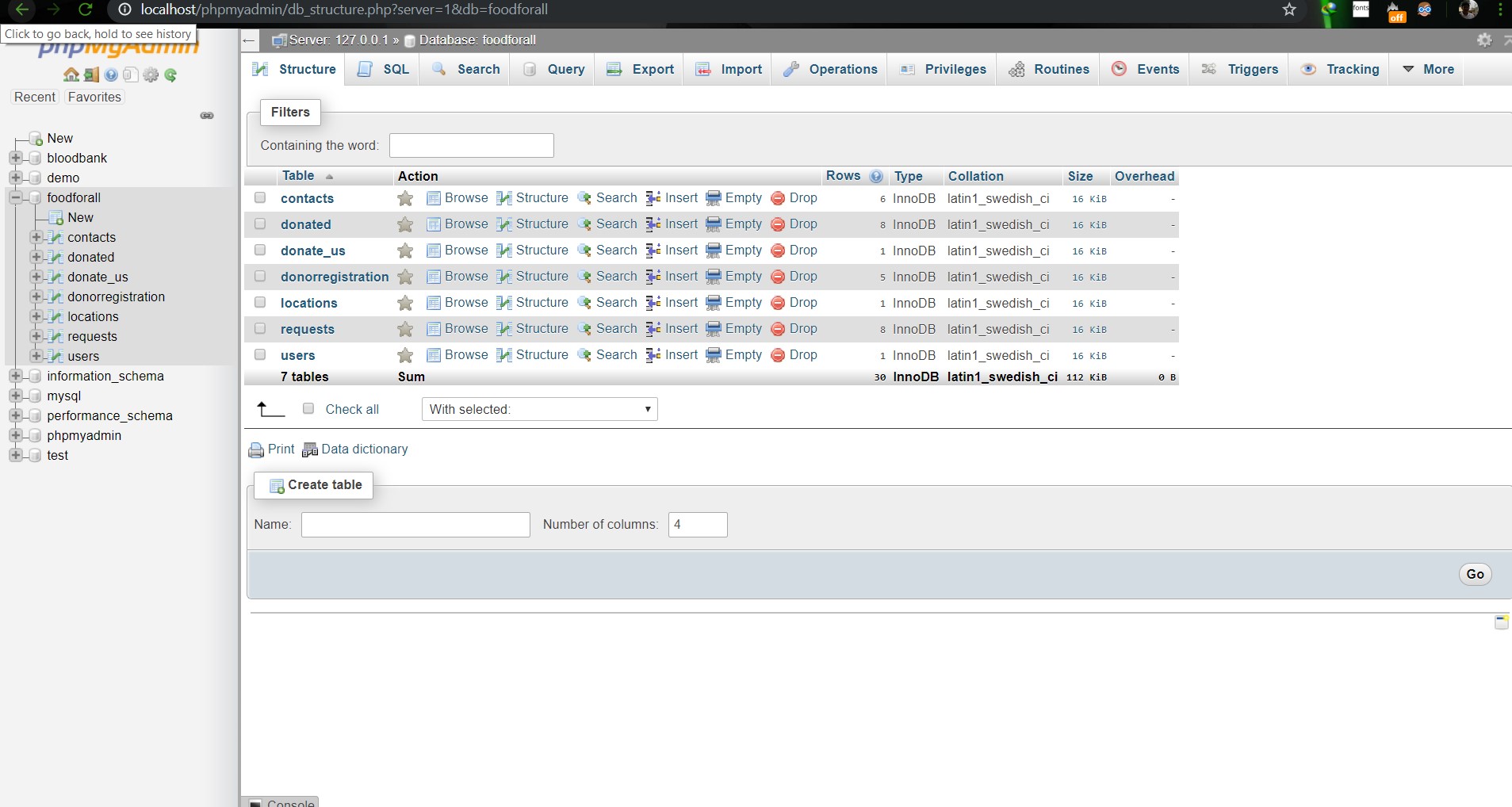                        **Image: DB(Foodforall)** <br> 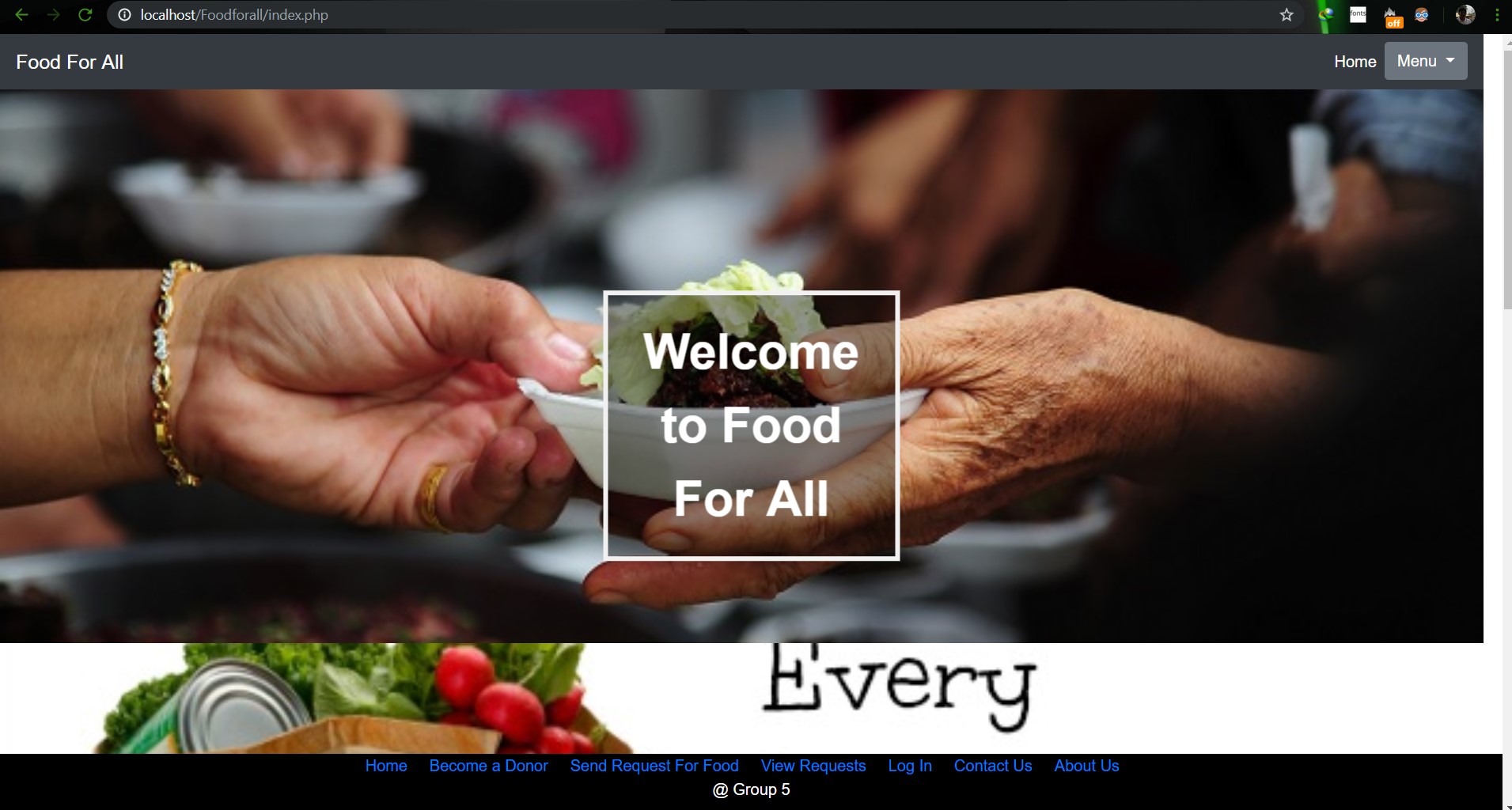                         **Image: Homepage** <br> 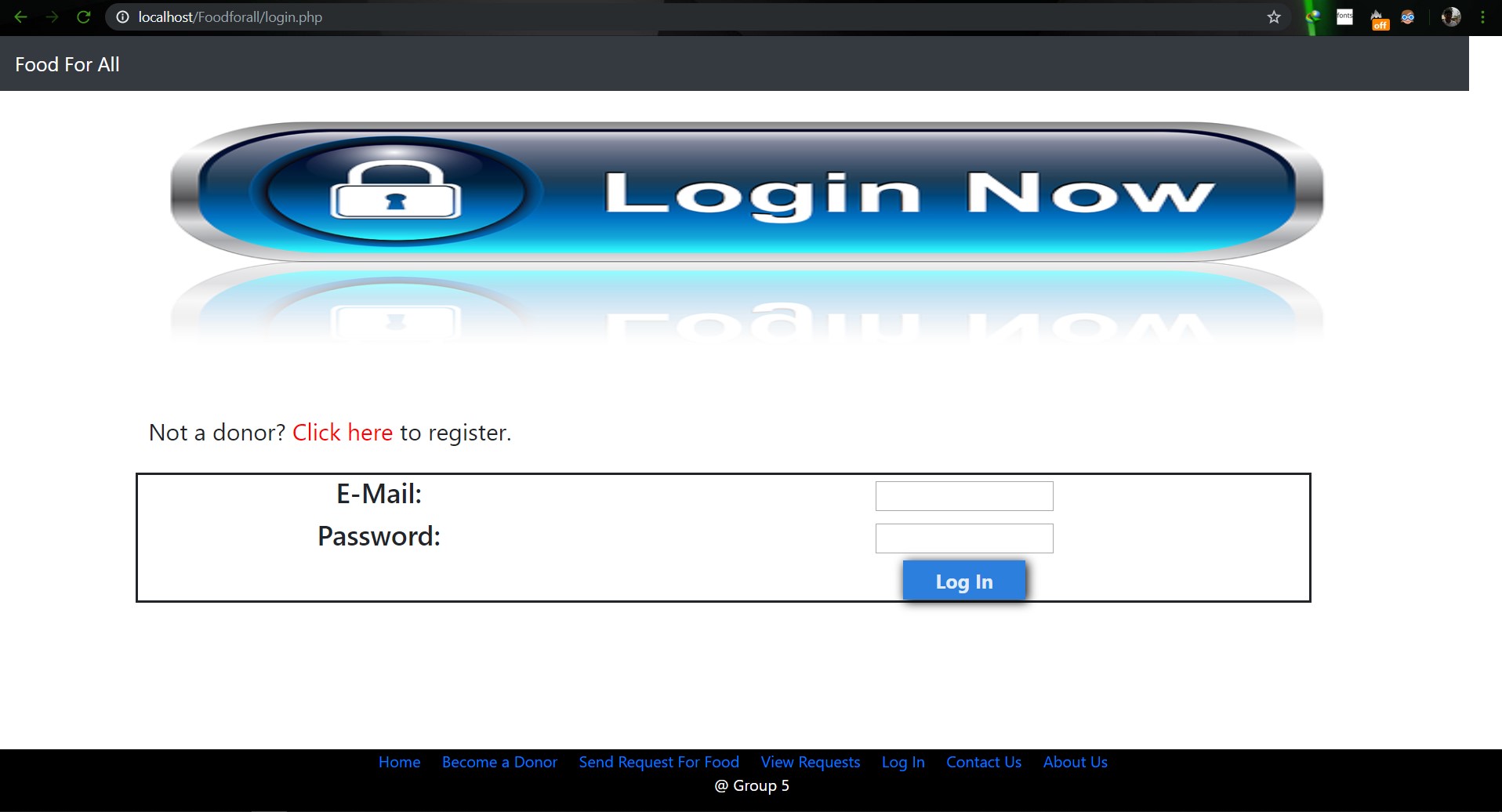                         **Image: Login Page** <br> 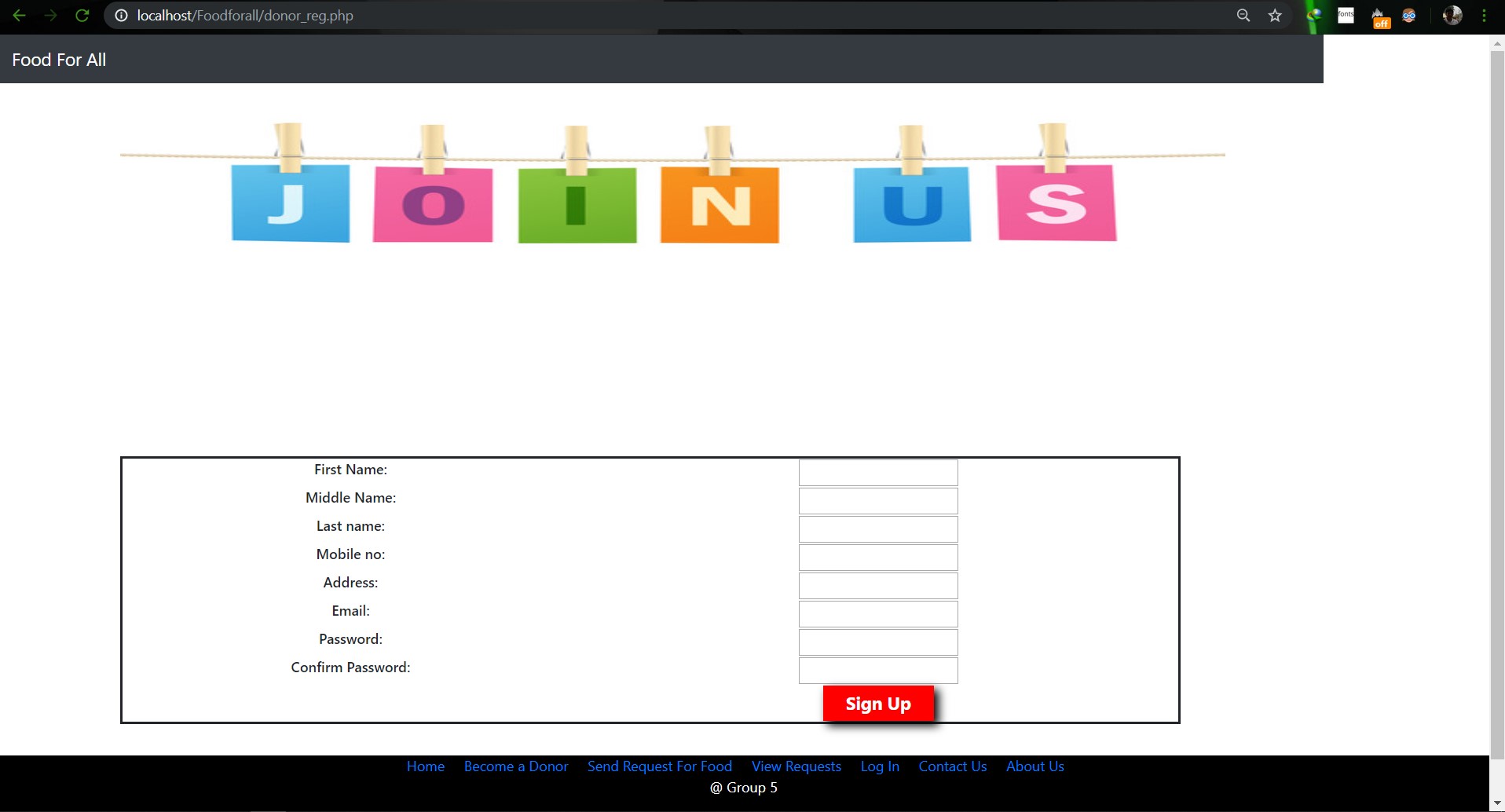                        **Image: Join us Page** <br> 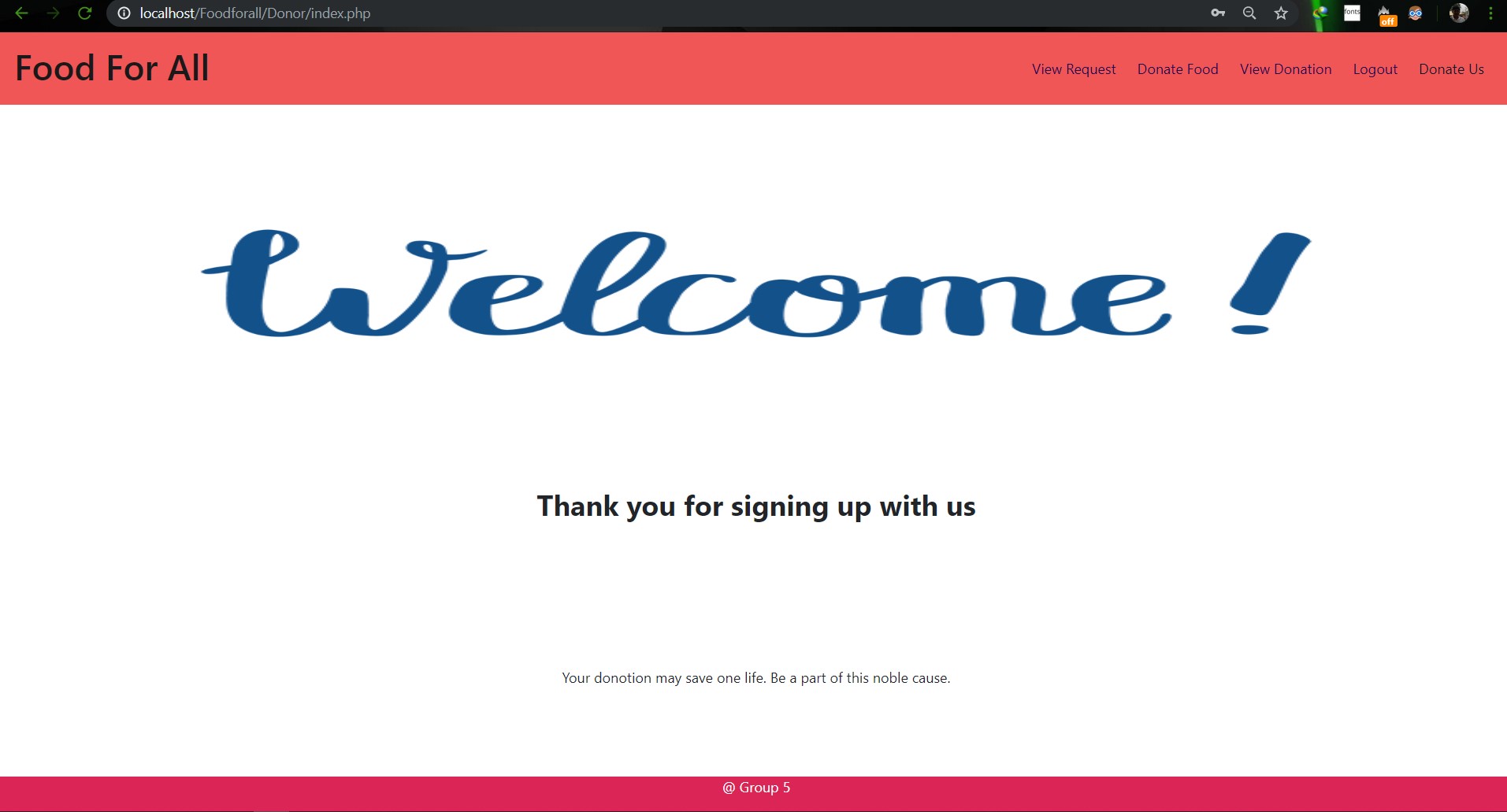                        **Image: Donor Login Page** <br> 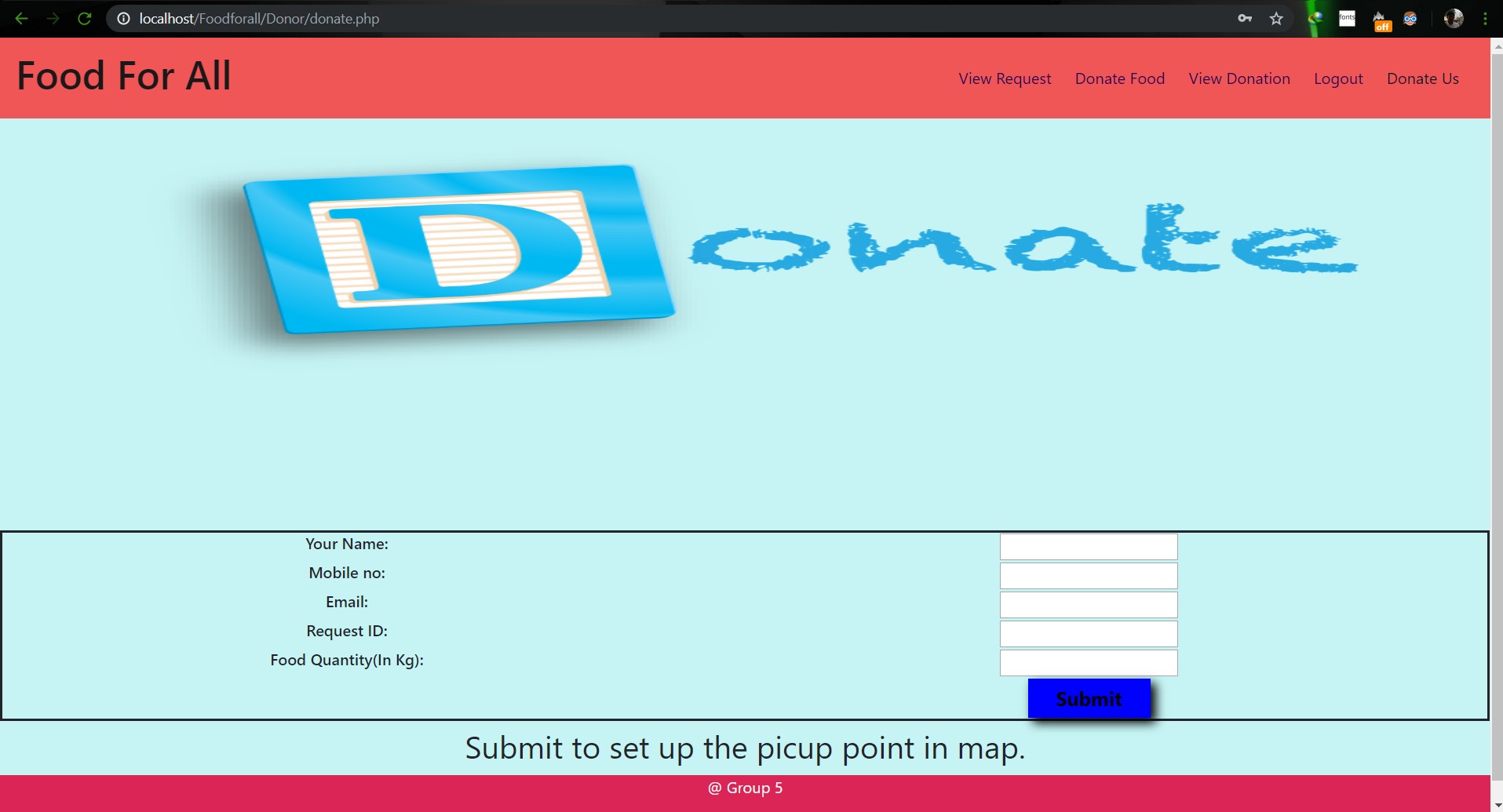                        **Image: Food Donation** <br> 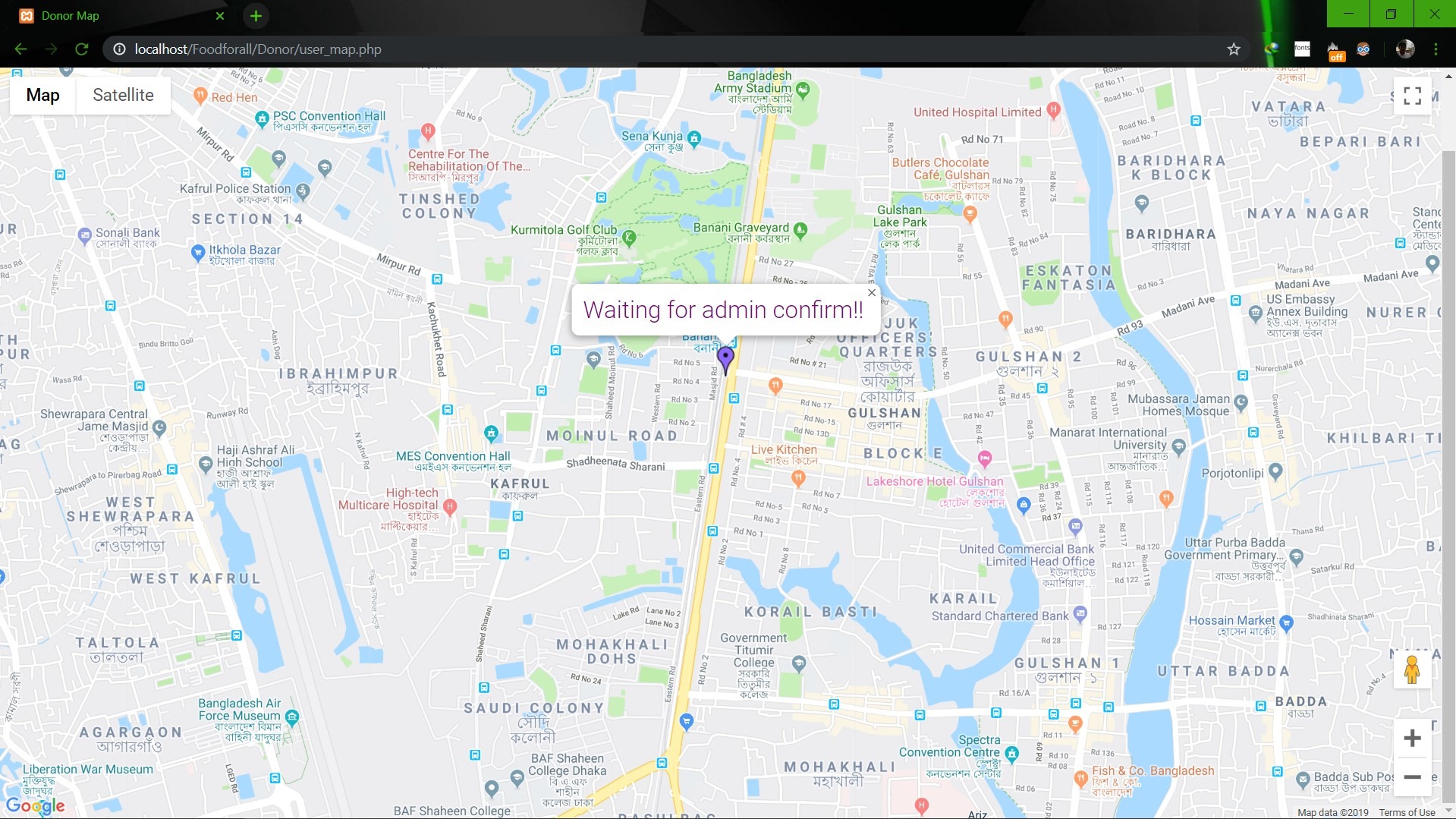                        **Image: User map** <br> 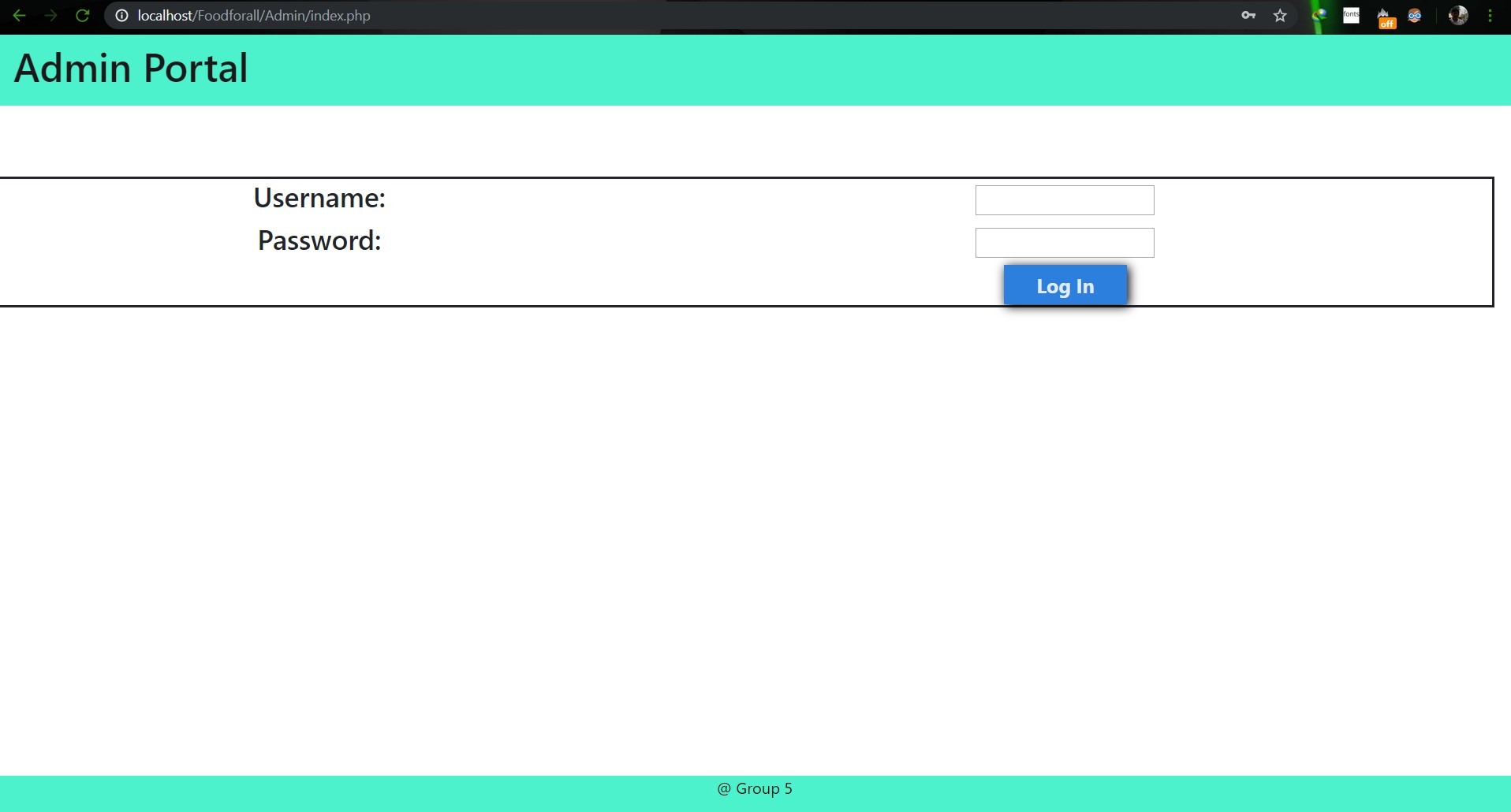                        **Image: Admin Login** <br> 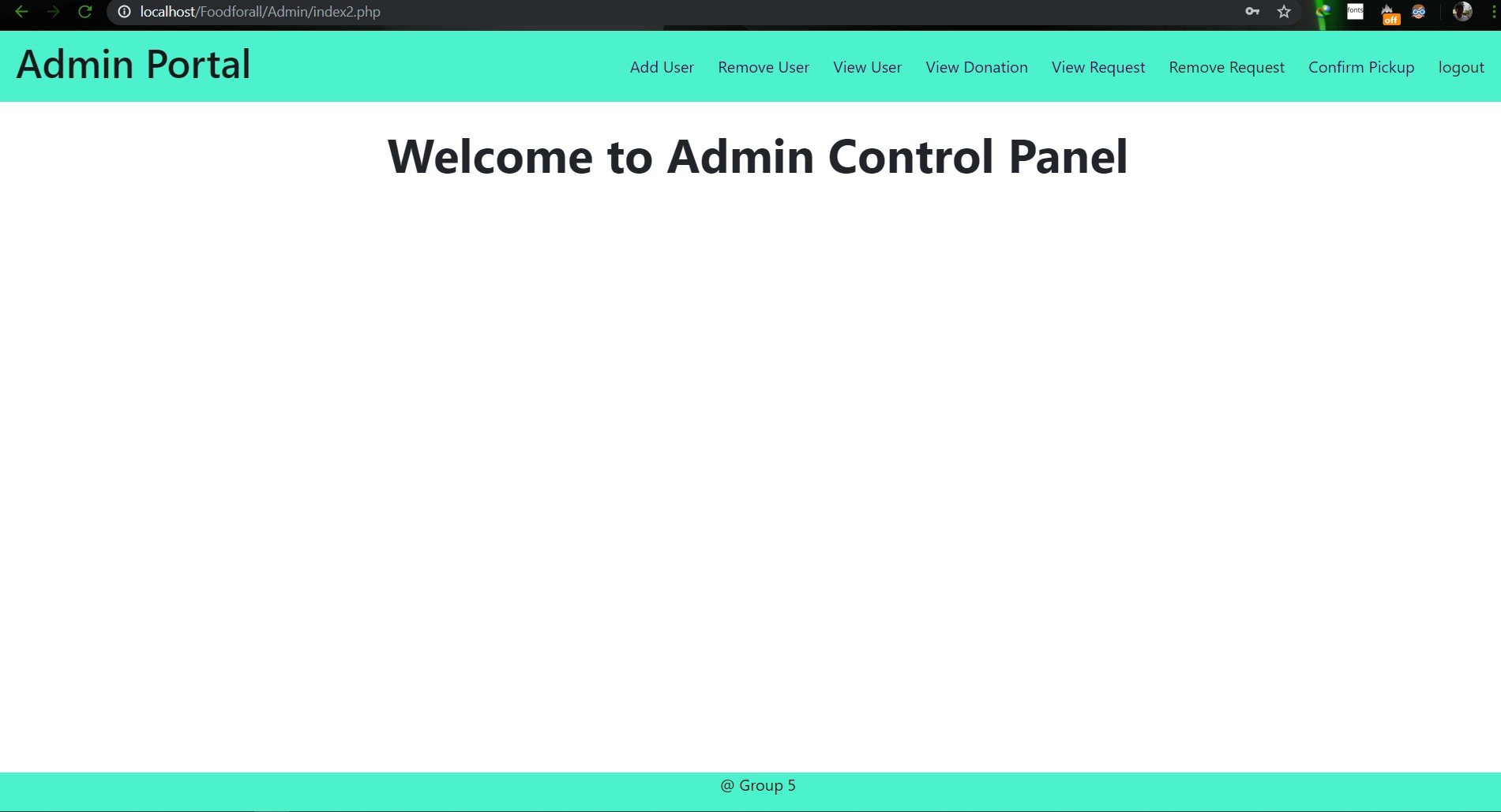                        **Image: Admin Home** <br> 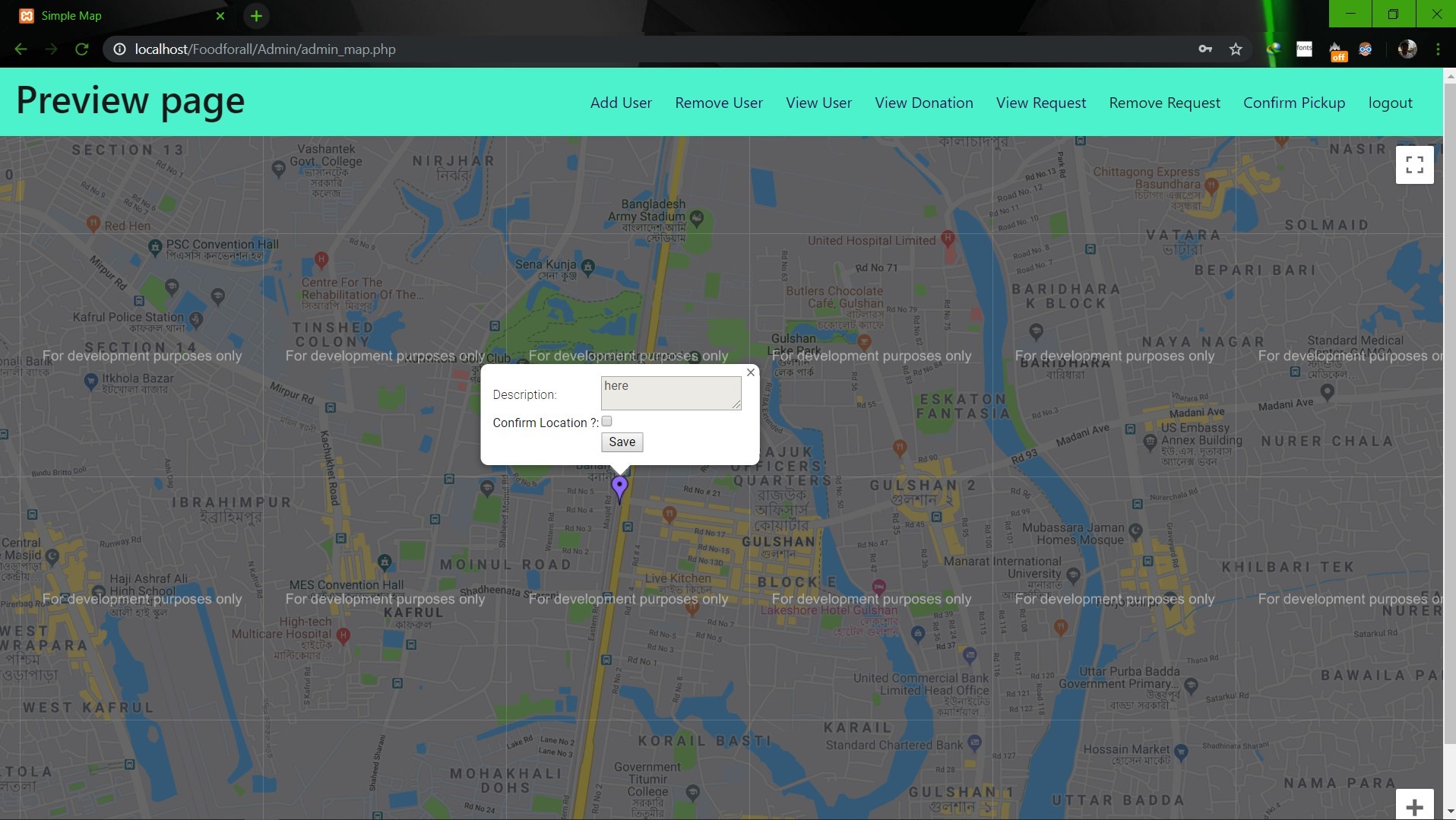                        **Image: Admin map** <br><br><br> **Conclusion:** 1. First of all we learnt how to use Github. It was completely new for us. But we now know how to use it. 2. We learnt about PHP, HTML and How to create DB connection in Mysql to create a project. 3. If we have more time we may be able to make the full project work properly. 4. In future, if we get chance we also want to create a android app for this weabsite. **References:** 1.https://getbootstrap.com/docs/4.3/examples/starter-template/ 2.https://www.w3schools.com/ 3.https://www.youtube.com/ 4.https://stackoverflow.com/questions/22138746/php-form-not-inserting-into-mysql-database 5.https://www.google.com/search?q=html+color+picker&oq=html+&aqs=chrome.0.69i59j69i57j69i60j69i65l2j69i60.3167j0j7&sourceid=chrome&ie=UTF-8 6.https://www.geeksforgeeks.org/ 7.https://www.youtube.com/watch?v=q2VV3-yWupU 8.https://bitbucket.org/webeasystep/markers_manager_php_mysql/src/master/
iliebabcenco
This is the basic Spring configuration for future apps. It has Maven' pom.xml for dependencies, Jdbc Template for accessing the database (SQL), some controllers, for example, Thymeleaf on front.
shbnq422
بسم الله الرحمن الرحيم C.V. NAME: SHA'BAN YOUSEF MOHAMMAD ELQASASS TELE PHONE NO. : 0799455189 NATIONALITY: JORDANIAN ADDRESS: JORDAN-AMMAN E-MAIL: SHBNQ422@YAHOO.COM WWW.SHAABANALQASSAS.COM CERTIFICATES: • HIGHER DIPLOMA IN INFORMATION TECHNOLOGY ( THE UNIVERSITY OF JORDAN) • B.CS IN CHEMISTRY AND COMPUTER FROM YARMOUK UNIVERSITY JORDAN • MCAD.NET (MICROSOFT CERTIFIED APPLICATION DEVELOPER 2003) • ADO.NET; ASP.NET ; MVC :LINQ :VB.NET : C# • MS SQL SERVER DATABASE 2005-2008-2012-2014 • ACCESSING DATA WITH MICROSOFT .NET FRAMEWORK 4 CERTIFICATE -MICROSOFT • JOOMLA WEBSITES DEVELOPER • PHP; MYSQL DATABASE; • MICROSOFT CERTIFIED TECHNOLOGY SPECIALIST (MCTS 2013) • CERTIFICATE DEVELOPING DATA ACCESS SOLUTIONS- MICROSOFT • CERTIFICATE DEVELOPING WEB APPLICATIONS – MICROSOFT • CERTIFICATE ADMIN TEAM FOUNDATION SERVER – MICROSOFT • CERTIFICATE DEVELOPING SILVERLIGHT – MICROSOFT • OFFICIAL TRANING IN ARCGIS 10.1 (I) – BY ESRI • OFFICIAL TRANING IN ARCGIS 10.1 ( II) – BY ESRI • OFFICIAL TRANING IN ARCGIS 10.1 ( III) performing analysis – BY ESRI • OFFICIAL TRANING IN ARCGIS 10.1 ( BUILDING GEODATABASE) – BY ESRI • OFFICIAL TRANING IN IMPLEMENTING VERSIONED WORKFLOWS IN A MULTIUSER GEODATABASE – BY ESRI • OFFICIAL TRANING IN ARCGIS 10.1 ( BUILDING WEB APPLICATION USING THE ARCGIS API ) – BY ESRI • OFFICIAL TRANING IN ARCGIS 10.1 ( INTRODUCTION TO ARCGIS SERVER) – BY ESRI • OFFICIAL TRANING IN ARCGIS 10.1 (CONFIGURING & MANAGING THE MULTIUSER GEODATABASE (SDE)) – BY ESRI • CERTIFICATE MAINTAINING MICROSOFT SQL SERVER DATABASE-MICROSOFT • CERTIFICATE IMPLEMENTING MICROSOFT SQL SERVER DATABASE REPORTING SERVICES- MICROSOFT • CERTIFICATE SHAREPOINT SERVER ADMINISTRATION- MICROSOFT • CERTIFICATE SHAREPOINT SERVER DEVELOPMENT- MICROSOFT • BUSINESS INTELLIGENCE TOOLS :DATA ANALYSIS SERVICES, DATA TRANSFORMATION SERVICES (DTS), DATA MIGRATION SERVICES, ETL (EXTRACT, TRANSFORM, AND LOAD) SERVICES, • ONLINE ANALYTICAL PROCESSING (OLAP) AND DATA-MINING TOOLS • CERTIFICATE WRITING QUERIES USING MICROSOFT SQL SERVER TRANSACT SQL –MICROSOFT • CERTIFICATE IMPLEMENTING AND MAINTAINING MICROSOFT SQL SERVER ANALYSIS SERVICES –MICROSOFT • CERTIFICATE IMPLEMENTING AND MAINTAINING MICROSOFT SQL SERVER INTEGRATION SERVICES –MICROSOFT • CERTIFICATE ADMINISTERING TEAM FOUNDATION SERVER • SYSTEM ADMINISTRATOR • Adobe program (graphics & design) • MS - SQL SERVER REPORTING SERVICE-OLAP-BI • SPSS ADVANCED TRAINING • ICDL CERTIFICATE • GEOMEDIA PROFESSIONAL GIS • GEOMEDIA WEBMAP GIS • GEOMEDIA TRANSPORTAION GIS • INTEL CERTIFICATE FUTURE FOR LEARNING • A+ COMPUTER MAINTENANCE (HARDWARE & SOFTWARE) • NETWORK + • SPECIALIZED COURSE IN METHODS OF CALCULATING THE RATE OF POPULATION GROWTH / DEPARTMENT OF STATISTICS • COURSE COMPLETION DEMOGRAPHIC / DEPARTMENT OF STATISTICS • SPECIALIZED COURSE IN THE MEASUREMENT OF IMMIGRATION / DEPARTMENT OF STATISTICS. • Develop GIS websites using GIS SILVERLIGHT asp.net technology. • Develop GIS websites using GIS flex technology. • Certificate projection methods and simulation models-UNESCO • Specialized course in fertility / Department of Statistics. • Specialized course in the measurement of levels and patterns of DEATH / DEPARTMENT OF STATISTICS • COURSE CODE POPULATION PROJECTIONS / DEPARTMENT OF STATISTICS • SPECIALIZED COURSE IN THE PREPARATION OF PROJECTIONS IN CRISES AND STRATEGIC PLANNING - UNESCO • WEB DESIGN USING DREAM WAVER • ASSOCIATE REGIONAL WORKSHOP ON EDUCATION STATISTICS - UNESCO INSTITUTE FOR STATISTICS • USING SPSS PROGRAM • ADVANCED COURSE IN STRATEGIC PLANNING AND THE PREPARATION OF INDICATORS • ADVANCED COURSE IN-DEPTH DEMOGRAPHIC ANALYSIS (U.S.BUREAU OF CENSUS) • ADVANCED COURSE IN POPULATION PROJECTIONS (U.S.BUREAU OF CENSUS) • EMIS EDUCATIONAL MANAGEMENT INFORMATION SYSTEM EXPERIENCES: • HEAD OF EMIS AND GIS DIVISION ) EDUCATIONAL MANAGEMENT INFORMATION SYSTEM( • HEAD OF PLANNING AND STATISTICS DIVISION • SUPERVISOR IN THE STATISTICS OF THE POPULATION IN THE KINGDOM IN 2004 AND DESIGNED STATISTICAL SOFTWARE.PARTICIPANT IN THE DEVELOPMENT OF DATABASES AND SOFTWARE EDUCATIONAL INDICATORS SIDE WITH GIS MAPS OF SCHOOL • TEAM LEADER IN DEVELOPMENT OF INFORMATION SYSTEM PROJECT ERSP • TEAM LEADER IN DEVELOPMENT OF INFORMATION SYSTEM PROJECT OPENEMIS • PARTICIPANT IN THE DEVELOPMENT OF DATABASES AND SOFTWARE STATISTICAL INFORMATION AND SURVEY FOR SCHOOL FOOD.. UNITED NATIONS WORLD FOOD PROGRAMME (WFP) • PARTICIPANT IN THE DEVELOPMENT OF DATABASES AND SOFTWARE STATISTICAL INFORMATION EMIS-EDUWAVE. • DEVELOP AND MANAGE IMPLEMENTATION OF PROJECT COMMUNICATION STRATEGIES AND COORDINATE CHANGE MANAGEMENT. • NATIONAL COORDINATOR OF THE EDUCATION INDICATORS WEI "WORLD EDUCATION INDICATOR" -UNESCO • DATABASE SPECIALISTS OF PARLIAMENTARY ELECTIONS • DATABASE ADMINISTRATION • DATABASE DESIGN, IMPLEMENTATION, TRANSACTION PROCESSING, REFERENTIAL INTEGRITY, PERFORMANCE TUNING AND MONITORING WITH AN EMPHASIS IN MS SQL. • MONITOR, REVIEW, AND VERIFY BACKUPS, RECOVERY, AND DISASTER RECOVERY PROCESSES. • CONTROL AND MONITOR USER ACCESS TO DATABASES AND MAINTAIN DATABASE SECURITY. • TROUBLESHOOT JOB FAILURES, PERFORMANCE ISSUES, DATABASE INTERGRITY, ETC. • MONITOR ALERTS AND TAKE CORRECTIVE ACTION OR ESCALATE ISSUES. • RESOLVE DATABASE REQUESTS AND ISSUES. • PERFORM DATABASE TUNING FOR OPTIMAL PERFORMANCE. • WORK CLOSELY WITH DEVELOPMENT AND NETWORK TEAMS ON RESOLVING ISSUES. • MAINTAIN DOCUMENTATION OF SYSTEMS AND STANDARD OPERATING POLICIES AND PROCEDURES. • ASSOCIATE IN THE DEVELOPMENT OF PARLIAMENTARY ELECTIONS SCHEDULES FOLLOW-UP AND THE RESULTS. • PARTICIPANTS IN THE INFORMATION SYSTEMS INTEGRATION PROJECT IN THE MINISTRY OF EDUCATION. • PARTICIPANT IN THE DEVELOPMENT OF DATABASES AND APPLICATION FOR SYRIAN REFUGEES CRISIS INFORMATION SYSTEM • PARTICIPANT IN THE LAMP (LITERACY ASSESSMENT AND MONITORING PROGRAM) –UNESCO • PARTICIPANT IN THE OUT OF SCHOOL CHILDREN STUDY – WITH UNICEF AND UNESCO • PARTICIPANT IN THE DEVELOPMENT OF THE DIRECTORATE AND THE SCHOOL (SDDP), • PARTICIPANT IN WORKSHOP FOR CHANGE MANAGEMENT –USAID • PARTICIPANT IN WORKSHOP FOR STATISTICAL INFORMATION –UNESCO &ALECSO- TUNIS • PARTICIPANT IN WORKSHOP FOR MONITORING AND EVALUATION -USAID • DESIGN AND CONSTRUCTION OF APPROPRIATE EDUCATIONAL POLICIES. • ADVANCED COURSE IN LEADERSHIP IN STRATEGIC COMMUNICATION • ADVANCED COURSE IN USING SPSS FOR DATA ANALYSIS • ADVANCED COURSE IN USING SPSS FOR DEMOGRAPHIC HEALTH SURVEYS • DESIGNER STATISTICAL SOFTWARE ESPECIALLY IN THE CAMPAIGN PROVIDES YALA MAY IN AMMAN IN 2009. • WEB SITE DEVELOPER AND DESIGN • PREPARE AND PARTICIPATE IN WORKSHOPS, INTERNATIONAL INDICATORS AND STRATEGIC PLANNING AND THE USE OF SOFTWARE AND DEVELOPMENT • PROGRAMMER IN PLANNING DIVISION SINCE 1/2004 • TEACHER FOR COMPUTER AND CHEMISTRY FROM 8/1995 • TRAINER FOR VISUAL BASIC.NET ADO.NET ASP.NET AND ICDL CERTIFICATE الاسم: شعبان يوسف محمد القصاص هاتف: 0799455189 فاكس :5666492 الجنسية: أردني العنوان: الأردن -عمان البريد الالكتروني: SHBNQ422@YAHOO.COM WWW.SHAABANALQASSAS.COM المؤهل العلمي: دبلوم عالي في تكنولوجيا المعلومات الجامعة الأردنية بكالوريوس كيمياء و حاسوب من جامعة اليرموك الأردنية عام 1993 شهادة مطور برمجيات ميكروسوفت من شركة ميكروسوفت العالمية ( MCAD .NET ) MS SQL server DATABASE 2005-2008-2012-2014 /ASP.NET/ ADO.NET/ VB.net C#: MVC : LINQ PHP ; MYSQL DATABASE دورة "أخصائي تكنولوجيا معتمد من مايكروسوفتMCTS MS - SQL SERVER REPORTING SERVICE –OLAP-BI MS ANALYSIS SERVICE System administrator Joomla website developer شهادةNETWORK + الدولية في شبكات الحاسوب شهادة التعليم للمستقبل INTEL لحوسبة التعليم شهادةA+ الدولية في صيانة الحاسوب شهادة نظم إدارة المعلومات التربوية EMIS وشهادة الخرائط الجغرافية GIS تدريب متخصص ArcGIS10.1 (I) شركة ESRI العالمية تدريب متخصص ArcGIS10.1 (II) شركة ESRI العالمية تدريب متخصص ArcGIS10.1 (III) performing analysis شركة ESRI العالمية تدريب متخصص ArcGIS10.1 (building geodatabase) شركة ESRI العالمية تدريب متخصص SharePoint إدارة وتطوير GEOMEDIA PROFESSIONAL GIS GEOMEDIA WEBMAP GIS GEOMEDIA TRANSPORTAION GIS دورة استخدام برمجيات المؤشرات والتحليل الاحصائي devinfo spectrum -- دورة متخصصة في اساليب حساب معدل النمو السكاني / دائرة الاحصاءات العامة دورة متخصصة في الاستكمال الديمغرافي / دائرة الاحصاءات العامة دورة متخصصة في قياس الهجرة / دائرة الاحصاءات العامة دورة متخصصة في الخصوبة / دائرة الاحصاءات العامة دورة متخصصة في قياس مستويات وانماط الوفاة / دائرة الاحصاءات العامة دورة متخصصة في برمجية الاسقاطات السكانية / دائرة الاحصاءات العامة Adobe program (graphics & design) تصميم مواقع الانترنت باستخدام Dream Waver استخدام برمجية SPSS في التحليل الاحصائي دورة متقدمة في التخطيط الاستراتيجي واعداد المؤشرات دورة متخصصة في اعداد الاسقاطات في الازمات والتخطيط الاستراتيجي - يونيسكو دورة متقدمة في التحليل الديمغرافي المعمق U.S.BUREAU OF CENSUS دورة متقدمة في الاسقاطات السكانية U.S.BUREAU OF CENSUS الخبرات: • رئيس قسم نظام إدارة المعلومات التربوية EMIS والخرائط GIS في وزارة التربية • رئيس قسم التخطيط والاحصاء التربوي في وزارة التربية والتعليم من تاريخ 2006 . • اعداد والمشاركة في ورش المؤشرات الدولية والتخطيط الاستراتيجي واستخدام برمجياتها وتطويرها • مشرف في الاحصاءات العامة للسكان في المملكة للعام 2004 ومصمم برمجيات احصائية. • تطوير مواقع انترنت الجغرافية باستخدام تقنية GIS SILVERLIGHT asp.net • تطوير مواقع انترنت الجغرافية باستخدام تقنية GIS flex • اخصائي قواعد بيانات في الهيئة المستقلة للانتخاب –الأردن • مدير فريق تطوير نظام إدارة المعلومات التربوي والمؤشرات التربية ERSP • مدير فريق تطوير نظام إدارة المعلومات التربوي والمؤشرات التربية OpenEMIS • مشارك في تطوير قواعد بيانات و معلومات الطلبة اللاجئين السوريين • مشارك في ورشة عمل في إدارة التغيير – USIAD • مشارك في ورشة عمل في المتابعة والتقييم - USIAD • مشارك في تطوير قواعد بيانات و برمجيات المؤشرات التربوية باستخدام الخرائط المدرسية GIS • مشارك في الانتخابات النيابية تطوير جداول المتابعة واصدار النتائج. • مشارك في تطوير قواعد بيانات وبرمجيات المعلومات الاحصائية EMIS-Eduwave • مشارك في مشروع تطوير المديرية والمدرسة (SDDP) ورسم وبناء السياسات التربوية . • مشارك في مشروع تكامل انظمة المعلومات في وزارة التربية والتعليم • مشارك في مشروع احصائيات معرفة القراءة والكتابة برنامج تقييم وتتبع مستويات القرائية LAMP • دورة متقدمة في القيادة في استراتيجية الاتصال . جامعة ميتشغان الامريكية • المنسق الوطني لمؤشرات التعليم WEI "World Education Indicator " -UNESCO • مشارك في ورشة عمل الاقليمية حول احصاءات التعليم – معهد اليونسكو للاحصاء • مصمم برمجيات احصائية خاصة في حملة يالا نوفر مي في عمان للعام 2009 • مطور ومصمم مواقع انترنت • مبرمج في قسم التخطيط في مديرية التربية والتعليم .تطوير برامج الحاسوب لحوسبة أعمال القسم من تاريخ 2004 • مدرس لمادتي الكيمياء والحاسوب للمرحلة الثانوية والأساسية من تاريخ 1995 • مدرب لبرمجية visual basic .net asp.net ado.net من تاريخ 2004 • مدرب لشهادة الحاسوب الدولية ICDL)) من تاريخ 2001
upupnoah
SQL Reflections: A sanctuary for exploring the art of SQL. Join me on a journey of learning, tutorials, and code snippets as we unravel the depths of structured query language. Discover the hidden wisdom within the realms of data.
No description available
Biswayan375
This repository contains some text files and some .sql files for tutorial and future reference purposes. All queries and other things are based on Oracle 10.
This repository provides a guide on how to use SQL to analyze email campaign performance and extract insights that can help optimize future campaigns.
diasvictorj
# Trybe This repository contains all the learning activities developed by João V.S Dias https://www.linkedin.com/in/diasvictorj/_ while studying at [Trybe](https://www.betrybe.com/) :rocket: _"Trybe is a school of the future for anyone who wants to improve their life and build a successful career in technology, where people only pay when they get a good job."_ The program has more than 1,500 hours of classroom and online classes, covers an introduction to software development, front-end, back-end, computer science, software engineering, agile methodologies and behavioral skills. ## Web Development Fundamentals :white_check_mark: ##### Block 1: Introduction - Unix & Shell - [ ] 1-3: _Unix & Shell- Part 1_ - [ ] 1-4: _Unix & Shell- Part 2_ ##### Block 2: Git & GitHub - [ ] 2-1: _What is it and what is it for?_ - [ ] 2-2: _Understanding the commands_ - [ ] 2-3: _Internet - Understanding how it works_ ##### Block 3: Introduction - HTML & CSS - [ ] 3-1: _HTML & CSS - Page Structures_ - [ ] 3-2: _HTML & CSS - Getting Started with CSS_ - [ ] 3-3: _HTML & CSS - Selectors and positioning_ - [ ] 3-4: _Semantic HTML_ - [ ] 3-5: _[Project - HTML & CSS]()_ ##### Block 4: Introduction - JavaScript - [ ] 4-1: _JavaScript - First steps_ - [ ] 4-2: _JavaScript - Array and For_ loop - [ ] 4-3: _JavaScript - Programming Logic and Algorithms_ - [ ] 4-4: _JavaScript - Objects and Functions_ - [ ] 4-5: _[Project - Playground Functions]()_ ##### Block 5: Introduction - JavaScript - Projects - [ ] 5-1: _JavaScript - DOM and selectors_ - [ ] 5-2: _JavaScript - Working with elements_ - [ ] 5-3: _JavaScript - Events_ - [ ] 5-4: _JavaScript - Web Storage_ - [ ] 5-5: _[Project - Meme Generator]()_ - [ ] 5-6: _[Project - Pixel Art]()_ - [ ] 5-7: _[Project - Task List]()_ - [ ] 5-7: _[Project - Guess the Color]()_ - [ ] 5-7: _[Project - Mysterious Letter]()_ ##### Block 6: Advanced HTML & CSS - [ ] 6-1: _HTML & CSS - Forms_ - [ ] 6-2: _JavaScript Libraries and CSS Frameworks_ - [ ] 6-3: _CSS Flexbox - Part 1_ - [ ] 6-4: _CSS Flexbox - Part 2_ - [ ] 6-5: _CSS Responsive - Mobile First_ - [ ] 6-6: _[Project - Facebook homepage]()_ ##### Block 7: JavaScript ES6 & Unit Tests - [ ] 7-1: _JavaScript ES6 - let, const, arrow functions and template literals_ - [ ] 7-2: _JavaScript ES6 - Objects_ - [ ] 7-3: _Unit tests in JavaScript_ - [ ] 7-4: _[Project - JavaScript Unit Tests]()_ ##### Block 8: JavaScript ES6 - [ ] 8-1: _JavaScript ES6 - Higher Order Functions - forEach, find, some, every, sort_ - [ ] 8-2: _JavaScript ES6 - Higher Order Functions - map and filter_ - [ ] 8-3: _JavaScript ES6 - Higher Order Functions - reduce_ - [ ] 8-4: _JavaScript ES6 - spread operator, rest parameter, destructuring and more_ - [ ] 8-5: _[Project - Zoo functions]()_ ##### Block 9: Asynchronicity & Callbacks - [ ] 9-1: _Asynchronous JavaScript and Callbacks_ - [ ] 9-2: _JavaScript Promises_ - [ ] 9-3: _[Project - Shopping Cart]()_ ##### Block 10: Jest - [ ] 10-1: _First steps in Jest_ - [ ] 10-2: _Jest - Asynchronous Tests_ - [ ] 10-3: _Jest - Simulating behavior_ - [ ] 10-4: _[Project - Asynchronous Jest and Mocking]()_ ## Front-end development :hourglass_flowing_sand: ##### Block 11: Introduction - React - [ ] 11-1: _'Hello, world!' on React!_ - [ ] 11-2: _React Components_ - [ ] 11-3: _[Project - Movie Cards Library]()_ ##### Block 12: React - [ ] 12-1: _Components with status_ - [ ] 12-2: _Events and forms in React_ - [ ] 12-3: _[Project - Movie Cards Library Stateful]()_ ##### Block 13: React - [ ] 13-1: _Improving component reuse: props.children and PropTypes_ - [ ] 13-2: _Component lifecycle in React_ - [ ] 13-3: _React Router_ - [ ] 13-4: _[Project - Movie Cards Library CRUD]()_ ##### Block 14: Agile Methodologies - [ ] 14-1: _Agile Methodologies_ - [ ] 14-2: _[Project - Frontend Online Store]()_ ##### Block 15: Tests in React - [ ] 15-1: _Testing React with the React Testing Library_ - [ ] 15-2: _Testing React with the React Testing Library - Part 2_ - [ ] 15-3: _[Project - Tests in React]()_ ##### Block 16: Introduction to Redux - [ ] 16-1: _Introduction to Redux_ - [ ] 16-2: _React with Redux - Part 1_ - [ ] 16-3: _React with Redux - Practice_ - [ ] 16-4: _React with Redux - Part 2_ - [ ] 16-5: _Synchronous tests with React-Redux_ - [ ] 16-6: _[Project - Table with data filters]()_ ##### Block 17: Project React - [ ] 17-1: _[Project - Trivia Game]()_ ##### Block 18: React & Context API - [ ] 18-1: _Context API of React_ - [ ] 18-2: _React Hooks - useState and useContext_ - [ ] 18-3: _React Hooks - useEffect and Custom Hooks_ - [ ] 18-4: _[Project - StarWars Datatable with Context API and Hooks]()_ ##### Block 19: Front-end Final Project - [ ] 19-1: _[Project - Recipe App]()_ ## Back-end Development :hourglass_flowing_sand: ##### Block 20: Introduction - Relational Databases - [ ] 20-1: _SQL Database_ - [ ] 20-2: _Finding data in a database_ - [ ] 20-3: _Filtering data specifically_ - [ ] 20-4: _Manipulating tables_ - [ ] 20-5: _[Project - All For One]()_ ##### Block 21: Relational Databases - [ ] 21-1: _Most used functions in SQL_ - [ ] 21-2: _Uncomplicating JOINs and UNIONs_ - [ ] 21-3: _Stored Routines & Subqueries_ - [ ] 21-4: _[Project - Vocabulary Booster]()_ ##### Block 22: Relational Databases - [ ] 22-1: _Transforming ideas into a database model_ - [ ] 22-2: _Normalization, Normal Forms and Dumps_ - [ ] 22-2: _Turning ideas into a database model - Part 2_ - [ ] 22-3: _[Project - One For All]()_ ##### Block 23: Introduction - NoSQL - [ ] 23-1: _MongoDB - Introduction_ - [ ] 23-2: _Filter Operators_ - [ ] 23-3: _[Project - Date Flights]()_ ##### Block 24: Updates - [ ] 24-1: _Simple Updates_ - [ ] 24-2: _Complex Updates - Arrays - Part 1_ - [ ] 24-3: _Complex Updates - Arrays - Part 2_ - [ ] 24-4: _[Project - Commerce]()_ ##### Block 25: Aggregation Framework - [ ] 25-1: _Aggregation Framework - Part 1_ - [ ] 25-2: _Aggregation Framework - Part 2_ - [ ] 25-3: _[Project - Aggregations]()_ ##### Block 26: Intro - NodeJS - [ ] 26-1: _NodeJS - Introduction_ - [ ] 26-2: _NodeJS - Asynchronous Flow_ - [ ] 26-3: _NodeJS - Architecture_ - [ ] 26-4: _[Project - A CLI of Ice and Fire]()_ ##### Block 27: NodeJS - [ ] 27-1: _Express: HTTP with Node.js_ - [ ] 27-2: _Software Architecture - Introduction to MVC_ - [ ] 27-3: _[Project - Cookmaster]()_ ##### Block 28: NodeJS - [ ] 28-1: _Software Architecture - Service Layer_ - [ ] 28-2: _Web Architecture - Rest and Restful_ - [ ] 28-3: _[Project - Store Manager]()_ ##### Block 29: NodeJS - [ ] 29-1: _NodeJS - JWT - (JSON Web Token)_ - [ ] 29-2: _NodeJS - Upload files with Multer_ - [ ] 29-3: _[Project - Cookmaster V2]()_ ##### Block 30: Introduction - Deploy - [ ] 30-1: _Infrastructure - Deploy with Heroku_ - [ ] 30-2: _Deploy - Process Managers_ - [ ] 30-3: _[Project - Stranger Things]()_ ##### Block 31: Project - [ ] 31-1: _[Project - Trybeer]()_ ##### Block 32: Software Architecture - [ ] 32-1: _Architecture - SOLID Principles_ - [ ] 32-2: _ORM - Application interface with the database_ - [ ] 32-3: _Software Architecture - DDD_ - [ ] 32-4: _Good practice writing tests_ - [ ] 32-3: _[Project - Blogs API]()_ ##### Block 33: Sockets - [ ] 30-1: _Sockets - TCP/UDP & NET_ - [ ] 30-2: _Sockets - Socket.io_ - [ ] 30-3: _[Project - Webchat]()_ ##### Block 34: Project - [ ] 34-1: _[Project - Trybeer V2]()_ ## Computer Science :hourglass_flowing_sand: ##### Block 35: Introduction - Computer Science - [ ] 35-1: _Computer Architecture_ - [ ] 35-2: _Network architecture_ - [ ] 35-3: _Computer networks, tools and security_ - [ ] 35-4: _[Project - Exploring the protocols]()_ ##### Block 36: Python - [ ] 35-1: _Learning Python_ - [ ] 35-2: _Tests and Exceptions_ - [ ] 35-3: _Data Input and Output_ - [ ] 36-4: _Data Input and Output_ - [ ] 35-5: _[Project - Tech news]()_ # [...]
Rohitlakha
Professional dashboard project using Power BI and SQL Server to analyze and visualize loan application data, with plans to extend into Python visualizations in future.
connectusmanali
This project is the analysis and future prediction of the data scientist salary. In this project, I got data from Kaggle, use SQL for data analysis and data cleaning. Further, I used Excel for pivot tables and use Tableau .
Mrigaank-9
QueryBuilder is a modular backend system and CLI tool that allows you to run read-only SQL queries on CSV/Excel files locally, without setting up a traditional database. It provides a CLI-first approach, with Streamlit GUI planned for future releases.
asp3
A banking tool for the future. We developed it using Django, a web framework, along with Python, Javascript, and Microsoft SQL Servers. Administrators can keep track of class funds and money raised during events such as fundraisers, while users can deposit money into their accounts, pre-order lunches and tickets, and view purchase history.
Mahmodul-Hasan
Skill Used: HTML, CSS, JavaScript, PHP, Jason, Bootstrap,Oracle Database,PL/SQL, Details: The project that we are offering is an inventory management system for the internal affairs of a confectionary. Inventory is an idle material resources of an enterprise awaiting future sales, use, or transformation. Inventory is the stock of any item or resource used in an organization and can include: raw materials, finished products, component parts, supplies and work-in- progress. This system provides information to efficiently manage the flow of materials, effectively utilize people and equipment, coordinate internal activities and communicate with customers.
CaptainEFFF
# Node Express Handlebars ### Overview In this assignment, you'll create a burger logger with MySQL, Node, Express, Handlebars and a homemade ORM (yum!). Be sure to follow the MVC design pattern; use Node and MySQL to query and route data in your app, and Handlebars to generate your HTML. ### Read This When trying to connect remotely to your Heroku database on an open network such as a coffee shop, library, or even your University WiFi, it will be blocked. If you are experiencing a Heroku connection error, this could be why. ### Important * **This assignment must be deployed.** Be sure to utilize the [MYSQL Heroku Deployment Guide](../../03-Supplemental/MySQLHerokuDeploymentProcess.pdf) in order to deploy your assignment. ### Before You Begin * Eat-Da-Burger! is a restaurant app that lets users input the names of burgers they'd like to eat. * Whenever a user submits a burger's name, your app will display the burger on the left side of the page -- waiting to be devoured. * Each burger in the waiting area also has a `Devour it!` button. When the user clicks it, the burger will move to the right side of the page. * Your app will store every burger in a database, whether devoured or not. * [Check out this video of the app for a run-through of how it works](https://youtu.be/msvdn95x9OM). ### Commits Having an active and healthy commit history on GitHub is important for your future job search. It is also extremely important for making sure your work is saved in your repository. If something breaks, committing often ensures you are able to go back to a working version of your code. * Committing often is a signal to employers that you are actively working on your code and learning. * We use the mantra “commit early and often.” This means that when you write code that works, add it and commit it! * Numerous commits allow you to see how your app is progressing and give you a point to revert to if anything goes wrong. * Be clear and descriptive in your commit messaging. * When writing a commit message, avoid vague messages like "fixed." Be descriptive so that you and anyone else looking at your repository knows what happened with each commit. * We would like you to have well over 200 commits by graduation, so commit early and often! ### Submission on BCS * **This assignment must be deployed.** * Please submit both the deployed Heroku link to your homework AND the link to the Github Repository! ## Instructions #### App Setup 1. Create a GitHub repo called `burger` and clone it to your computer. 2. Make a package.json file by running `npm init` from the command line. 3. Install the Express npm package: `npm install express`. 4. Create a server.js file. 5. Install the Handlebars npm package: `npm install express-handlebars`. 6. Install MySQL npm package: `npm install mysql`. 7. Require the following npm packages inside of the server.js file: * express #### DB Setup 1. Inside your `burger` directory, create a folder named `db`. 2. In the `db` folder, create a file named `schema.sql`. Write SQL queries this file that do the following: * Create the `burgers_db`. * Switch to or use the `burgers_db`. * Create a `burgers` table with these fields: * **id**: an auto incrementing int that serves as the primary key. * **burger_name**: a string. * **devoured**: a boolean. 3. Still in the `db` folder, create a `seeds.sql` file. In this file, write insert queries to populate the `burgers` table with at least three entries. 4. Run the `schema.sql` and `seeds.sql` files into the mysql server from the command line 5. Now you're going to run these SQL files. * Make sure you're in the `db` folder of your app. * Start MySQL command line tool and login: `mysql -u root -p`. * With the `mysql>` command line tool running, enter the command `source schema.sql`. This will run your schema file and all of the queries in it -- in other words, you'll be creating your database. * Now insert the entries you defined in `seeds.sql` by running the file: `source seeds.sql`. * Close out of the MySQL command line tool: `exit`. #### Config Setup 1. Inside your `burger` directory, create a folder named `config`. 2. Create a `connection.js` file inside `config` directory. * Inside the `connection.js` file, setup the code to connect Node to MySQL. * Export the connection. 3. Create an `orm.js` file inside `config` directory. * Import (require) `connection.js` into `orm.js` * In the `orm.js` file, create the methods that will execute the necessary MySQL commands in the controllers. These are the methods you will need to use in order to retrieve and store data in your database. * `selectAll()` * `insertOne()` * `updateOne()` * Export the ORM object in `module.exports`. #### Model setup * Inside your `burger` directory, create a folder named `models`. * In `models`, make a `burger.js` file. * Inside `burger.js`, import `orm.js` into `burger.js` * Also inside `burger.js`, create the code that will call the ORM functions using burger specific input for the ORM. * Export at the end of the `burger.js` file. #### Controller setup 1. Inside your `burger` directory, create a folder named `controllers`. 2. In `controllers`, create the `burgers_controller.js` file. 3. Inside the `burgers_controller.js` file, import the following: * Express * `burger.js` 4. Create the `router` for the app, and export the `router` at the end of your file. #### View setup 1. Inside your `burger` directory, create a folder named `views`. * Create the `index.handlebars` file inside `views` directory. * Create the `layouts` directory inside `views` directory. * Create the `main.handlebars` file inside `layouts` directory. * Setup the `main.handlebars` file so it's able to be used by Handlebars. * Setup the `index.handlebars` to have the template that Handlebars can render onto. * Create a button in `index.handlebars` that will submit the user input into the database. #### Directory structure All the recommended files and directories from the steps above should look like the following structure: ``` . ├── config │ ├── connection.js │ └── orm.js │ ├── controllers │ └── burgers_controller.js │ ├── db │ ├── schema.sql │ └── seeds.sql │ ├── models │ └── burger.js │ ├── node_modules │ ├── package.json │ ├── public │ └── assets │ ├── css │ │ └── burger_style.css │ └── img │ └── burger.png │ │ ├── server.js │ └── views ├── index.handlebars └── layouts └── main.handlebars ``` ### Reminder: Submission on BCS * Please submit both the deployed Heroku link to your homework AND the link to the Github Repository! - - - ### Minimum Requirements Attempt to complete homework assignment as described in instructions. If unable to complete certain portions, please pseudocode these portions to describe what remains to be completed. Hosting on Heroku and adding a README.md are required for this homework. In addition, add this homework to your portfolio, more information can be found below. - - - ### Hosting on Heroku Now that we have a backend to our applications, we use Heroku for hosting. Please note that while **Heroku is free**, it will request credit card information if you have more than 5 applications at a time or are adding a database. Please see [Heroku’s Account Verification Information](https://devcenter.heroku.com/articles/account-verification) for more details. - - - ### Create a README.md Add a `README.md` to your repository describing the project. Here are some resources for creating your `README.md`. Here are some resources to help you along the way: * [About READMEs](https://help.github.com/articles/about-readmes/) * [Mastering Markdown](https://guides.github.com/features/mastering-markdown/) - - - ### Add To Your Portfolio After completing the homework please add the piece to your portfolio. Make sure to add a link to your updated portfolio in the comments section of your homework so the TAs can easily ensure you completed this step when they are grading the assignment. To receive an 'A' on any assignment, you must link to it from your portfolio. - - - ### One More Thing This is a really tough homework assignment, but we want you to put in your best effort to finish it. If you have any questions about this project or the material we have covered, please post them in the community channels in slack so that your fellow developers can help you! If you're still having trouble, you can come to office hours for assistance from your instructor and TAs. ### Reminder When trying to connect remotely to your Heroku database on an open network such as a coffee shop, library, or even your University WiFi, it will be blocked. If you are experiencing a Heroku connection error, this could be why. **Good Luck!**